

Ask any practice manager what January feels like and you will hear a version of the same story. A senior resigns in the middle of the compliance run, three agencies are briefed in a single afternoon, and forty-eight hours later the inbox is full of CVs that have clearly been sent to every firm in the county. Six weeks later the role is still open, the team is covering the gap, and the partner who was meant to be winning advisory work is reading application forms instead.
The hiring market has made this worse rather than better. Qualified accountants remain in short supply across the UK, Australia and the EU, salaries for experienced staff have climbed well ahead of fee inflation, and the arrival of Making Tax Digital for Income Tax has added a fresh layer of compliance volume for practices that were already stretched. Hiring has stopped being an occasional administrative task and become a permanent operational problem.
That is exactly why the RPO vs traditional recruitment question keeps coming up in partner meetings. It is not really a question about suppliers. It is a question about whether hiring should stay an event you react to, or become a process you run.
What is the difference between RPO and traditional recruitment for accounting firms?
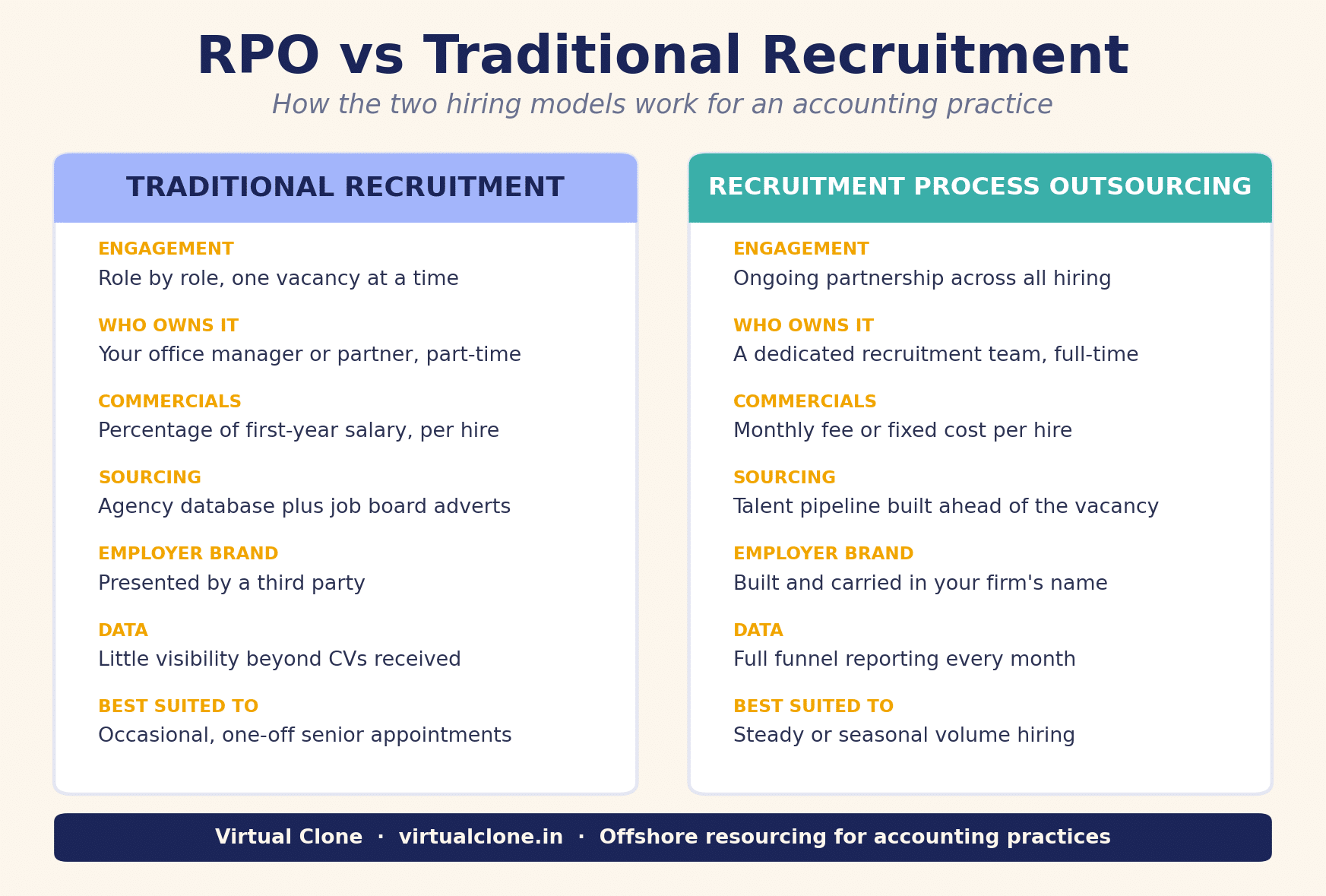
The difference is scope and ownership. Traditional recruitment is transactional: you engage an agency for one vacancy, they introduce candidates from their database, and you pay a placement fee if you hire one. The agency owns nothing beyond the introduction. Recruitment process outsourcing is a programme: an external provider takes ownership of all or part of your hiring process, works under your firm's name, builds a pipeline before the vacancy exists, and is measured on quality of hire, time to hire and cost per hire rather than on CVs submitted.
In plain commercial terms, an agency sells you an outcome one role at a time and has no reason to care what your hiring looks like next quarter. An RPO partner sells you a capability and is contractually tied to how your hiring performs over a year. That single difference in incentive explains almost everything else that follows.
How traditional recruitment works inside an accounting practice
In the contingent agency model, a partner or office manager writes a brief, sends it to two or three recruiters, and waits. Because the agencies are only paid if their candidate is the one appointed, they are competing against each other on speed, which means the first CVs usually arrive within a day. Fees typically sit between fifteen and twenty-five per cent of the first year's salary, so a £45,000 semi-senior appointment at a twenty per cent fee costs around £9,000 the moment they accept.
That structure creates a specific set of behaviours. Volume beats precision, because a recruiter who sends eight reasonable CVs has a better chance of a placement than one who sends two excellent ones. Nobody in the chain is responsible for your candidate experience, your careers page, or the reason three people turned you down last year. And because the relationship resets with every vacancy, nothing that was learned during the last search is carried into the next one.
Where the agency model still earns its keep
We should be fair to it, because there are situations where a good traditional recruiter is still the right answer. Confidential appointments at partner or director level benefit enormously from a discreet third party who can approach people you cannot approach yourself. Genuinely niche specialisms such as R&D tax, forensic accounting or complex VAT often sit inside one recruiter's personal network. And if you hire once every eighteen months, there is simply no volume to justify anything more structured.
Where it starts to strain
The model breaks down on repetition. Three or four hires a year at £8,000 to £11,000 each quietly becomes one of the larger discretionary lines in the practice budget, with nothing to show for it once the placements are made. Rebate periods protect you for twelve weeks and then stop mattering. Offers get declined because nobody managed the notice period conversation properly. And the firm's reputation in its own local market is being shaped, every single week, by recruiters who do not work for you.
How recruitment process outsourcing actually works
Under an RPO arrangement, a provider supplies the people, technology and process to run hiring on your behalf. In practice that usually means a named recruiter or small team who behave like an in-house function: they learn how your practice works, write and place the adverts, manage the applicant tracking system, screen and telephone-interview candidates, coordinate partner interviews, handle offers and counter-offers, and report on the whole funnel each month. Candidates deal with someone who introduces themselves using your firm's name, not an agency's.
Commercially it is usually structured in one of three ways. A monthly retainer covers an agreed volume of hiring and suits firms with a steady flow of vacancies. A fixed cost per hire keeps the economics familiar while removing the percentage-of-salary problem, so appointing a manager no longer costs three times what it costs to appoint a trainee. Project or modular RPO covers a defined burst, which is how most practices start: a graduate intake, an office opening, or resourcing a new outsourcing team.
| Stage of hiring | Traditional agency | RPO partner |
|---|---|---|
| Workforce planning | Not included | Owned, with a rolling hiring forecast |
| Job advert and employer brand | Written by the agency, posted in their name | Written for your firm, posted in your name |
| Sourcing and outreach | Existing database plus job boards | Database, boards, referrals and a warm talent pool |
| Screening and first interview | Light CV sift | Structured screen against an agreed scorecard |
| Interview coordination | Your team | The RPO team |
| Offer and notice management | Agency, until the fee is invoiced | Owned through to day one |
| Onboarding handover | Rarely included | Included in most programmes |
| Reporting to partners | None beyond CVs sent | Monthly funnel, cost and quality metrics |
RPO vs traditional recruitment: the full side-by-side comparison
Set out against each other, the two approaches are solving genuinely different problems. The table below is the summary we tend to walk through with practice leaders when the RPO vs traditional recruitment conversation gets to the detail, and it is worth reading the middle column charitably: contingent recruitment is not a bad model, it is a narrow one.
| Comparison point | Traditional recruitment | Recruitment process outsourcing |
|---|---|---|
| Commercial model | 15–25% of first-year salary, paid per placement | Monthly retainer or fixed cost per hire |
| Cost predictability | Rises with every salary increase | Budgeted in advance and volume-independent |
| Typical time to hire | 10–14 weeks for a qualified role | 6–9 weeks once the pipeline is warm |
| Who candidates meet first | An agency consultant | Someone representing your practice |
| Employer brand | Built by a third party, and rented | Built for you, and kept |
| Talent pipeline | Starts from zero at each vacancy | Maintained continuously between vacancies |
| Quality measurement | Did they pass probation? | Scorecards, 12-month retention, hiring manager rating |
| Internal time cost | High – partners sift and chase | Low – partners interview shortlists only |
| Compliance and right to work | Varies by agency | Standardised, documented and auditable |
| Best fit | One or two specialist hires a year | Four or more hires a year, or seasonal peaks |
How long does each model take to fill an accounting vacancy?
Speed is where the difference is most visible, and also most misunderstood. The notice period is the same whoever recruits: a qualified accountant on three months' notice is on three months' notice regardless of who introduced them. What changes is everything that happens before the offer, and that is where an established pipeline pays for itself.
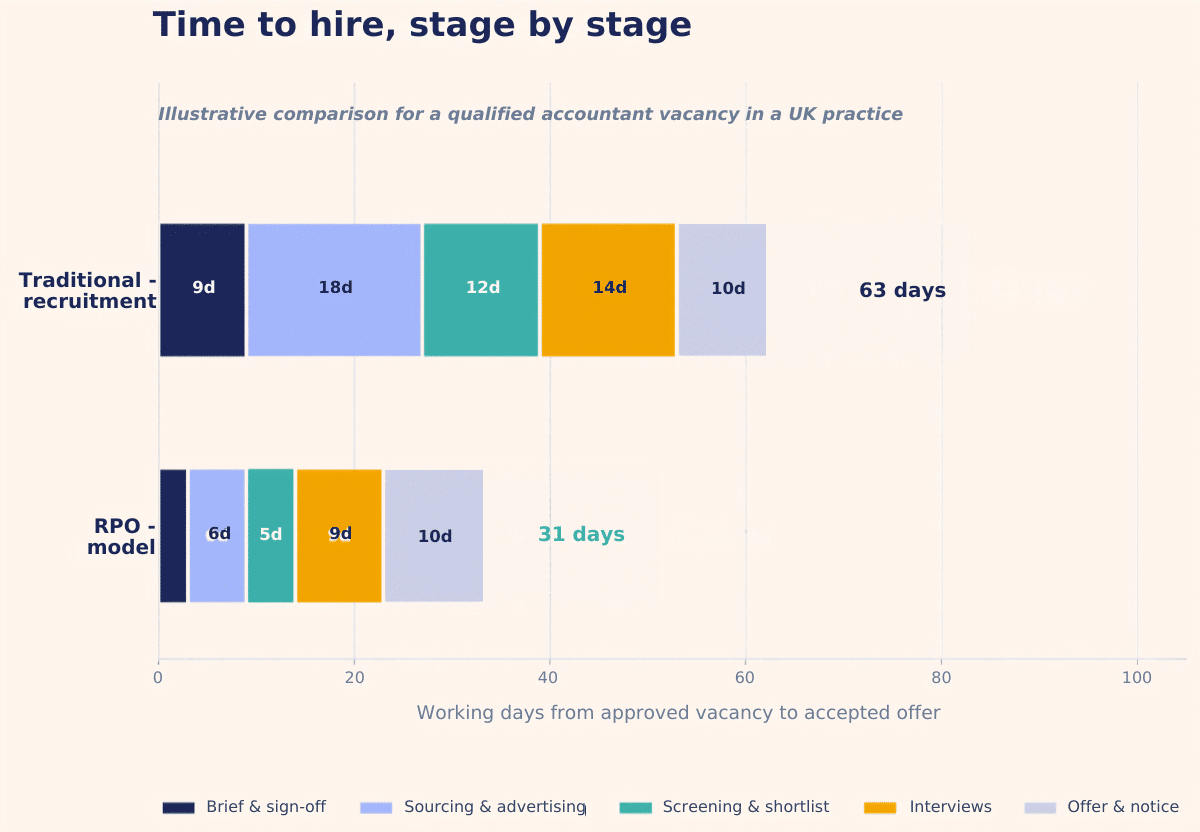
Because sign-off, sourcing and screening are already running before the vacancy is formally approved, an RPO programme typically removes three to five weeks from the front end. For a practice covering a gap with overtime and locum support, five weeks of lost capacity during the busy season is usually worth more than the entire recruitment fee being argued over.
What does the cost comparison really look like?
The RPO vs traditional recruitment cost comparison is where most partner conversations start, and the answer genuinely depends on volume. At two hires a year, agency fees are almost always cheaper than any retained arrangement, because you are only paying when something happens. Somewhere around the fourth or fifth hire the lines cross, and beyond ten hires a year the gap becomes difficult to ignore.
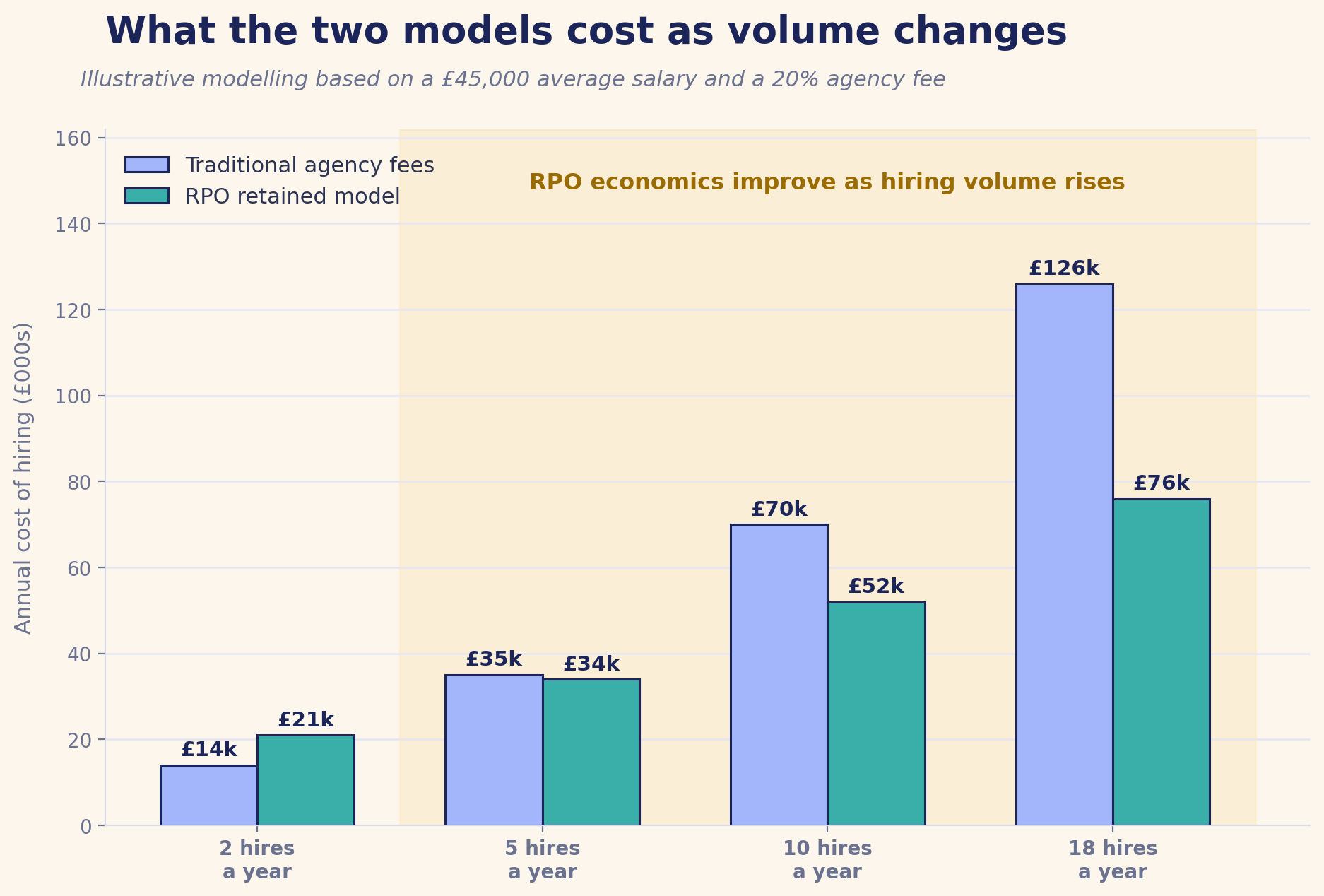
The modelled figures above are deliberately simple, and the real picture is usually worse for the traditional route than the chart suggests, because two large costs never appear on an invoice. The first is partner time: sifting, chasing and rescheduling is easily two working days per vacancy at a charge-out rate most firms would rather not calculate. The second is the cost of the role staying open, which for a fee-earning position is lost recoverable work every week it drags on.
| Cost element | Column 2 | Column 3 | Column 4 |
|---|---|---|---|
| Placement or programme fee | £9,000 per hire | £4,200–£5,500 per hire | Finance, immediately |
| Job board advertising | Paid again per vacancy | Included in the programme | Practice manager |
| Partner and manager time | Around 2 days per vacancy | Around 4 hours per vacancy | Nobody, until year end |
| Cost of the vacancy staying open | 10–14 weeks of lost capacity | 6–9 weeks of lost capacity | The team covering it |
| Repeat cost on a bad hire | Rebate for 12 weeks, then full fee | Replacement inside the programme | Everyone |
Quality of hire, retention and the cost of getting it wrong
The honest reason RPO vs traditional recruitment matters more than the fee comparison is that recruitment fees are a rounding error next to a bad appointment. A senior who leaves at month seven costs the practice the recruitment fee twice over, several months of partially recoverable work, the disruption to a client portfolio that has just learned a new name, and the morale of a team that has covered two handovers in a year.
Structurally, an embedded model has two advantages here. The first is context: someone who has sat in your office, understands that your audit team is more commercial than technical, and knows which partner mentors well is simply a better judge of fit than a consultant working from a job description. The second is incentive. When the provider is measured on twelve-month retention rather than on the placement itself, there is no commercial reward for pushing a marginal candidate over the line in week three.
Where offshore resourcing fits alongside both models
There is a third option that rarely appears in a straight RPO vs traditional recruitment comparison, and it is often the one that actually solves the problem. Before deciding how to hire, it is worth asking whether the practice needs another local employee at all, or whether it needs more capacity to get compliance work done.
For bookkeeping, VAT returns, year-end accounts preparation, payroll and self-assessment, a great deal of the workload is repeatable, process-driven and entirely deliverable from a well-run offshore delivery team. That route sidesteps the recruitment question completely: no advert, no shortlist, no notice period, and capacity live in weeks rather than months. It also protects the roles you genuinely do need locally, because your qualified people stop spending their week on processing and start spending it on advisory work and client relationships.
This is the work we do at Virtual Clone. We run delivery centres in Nagpur and Mumbai supporting accounting practices across the UK, Australia and the EU, working inside our clients’ own software and workflows. We are ISO 27001 and ISO 9001 certified and an ACCA Approved Employer, which matters when the work involves client data and professional standards rather than general back-office admin.
How to choose between RPO and traditional recruitment
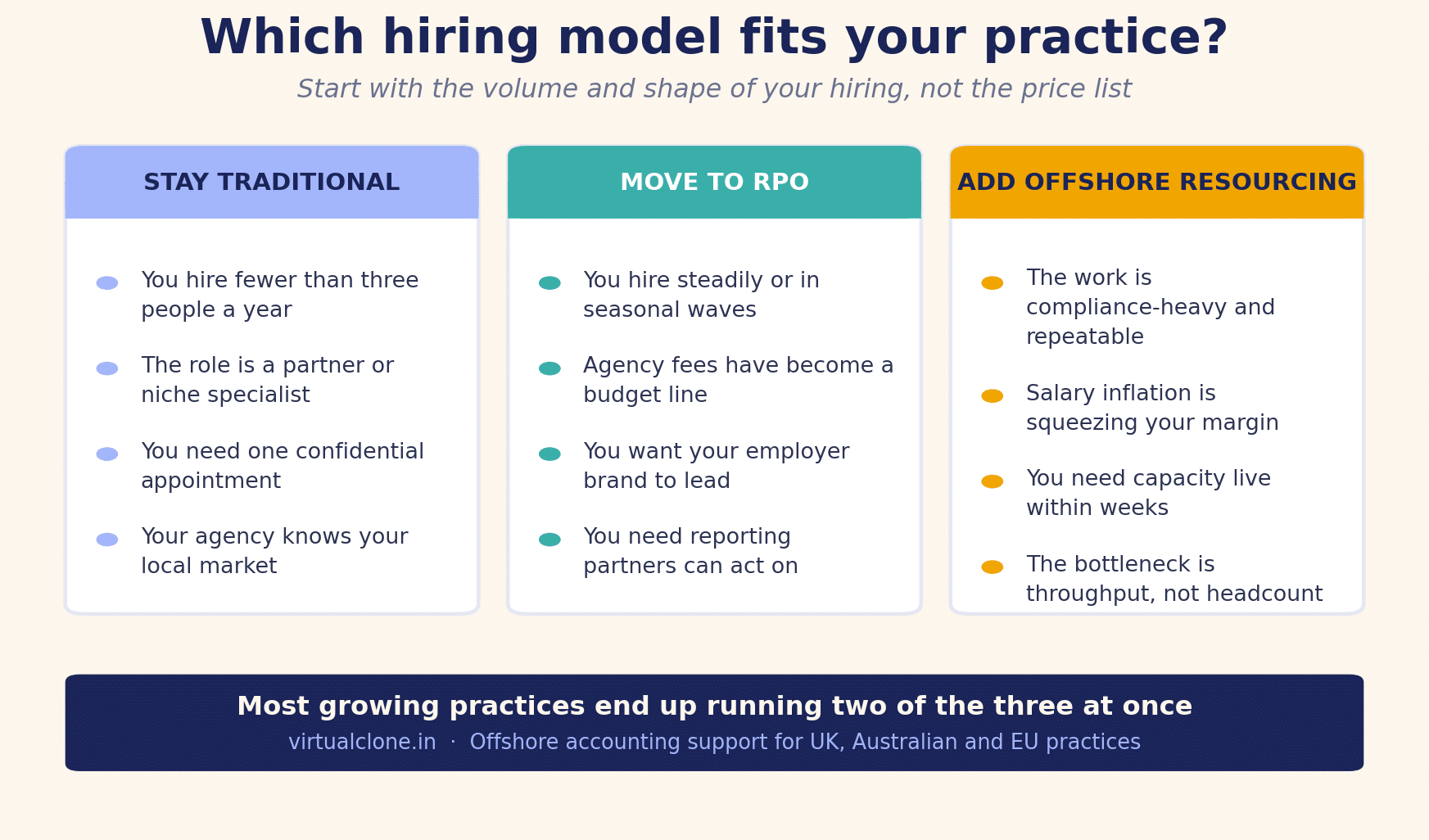
The decision is easier than it looks once the question is framed correctly. Rather than comparing suppliers, we suggest partners answer five questions about the practice itself, because the right model falls out of the answers almost automatically.
| Ask yourself | If the answer is… | Lean towards |
|---|---|---|
| How many people will we hire in the next twelve months? | Three or fewer | Traditional recruitment |
| Is our hiring steady, or does it come in waves? | Seasonal peaks around January and year end | Project or modular RPO |
| Can we say what a hire currently costs us, all in? | No, and nobody has ever measured it | RPO, for the reporting alone |
| Do candidates in our town know what it is like to work here? | Only what an agency has told them | RPO, to take the brand back |
| Is the real problem headcount, or throughput? | We simply cannot get the compliance work out | Offshore resourcing first |
Four mistakes practices make when they switch models
Moving from one model to the other is straightforward, but we see the same avoidable problems often enough to be worth naming.
| The mistake | What to do instead |
|---|---|
| Judging RPO on the fee per hire alone | Compare total cost of hiring, including partner time and the cost of the role sitting open |
| Signing a twelve-month programme before testing the fit | Start with a defined project – a graduate intake or one team and review the funnel data before extending |
| Keeping three agencies on the side as insurance | Running both models at once duplicates candidates and undermines the pipeline you are paying to build |
| Not agreeing what good looks like | Set time to hire, cost per hire, hiring manager satisfaction and twelve-month retention as the measures from day one |
Frequently asked questions
What does RPO stand for in recruitment?
RPO stands for recruitment process outsourcing. It describes an arrangement where an external provider takes over all or part of an organisation's hiring process, acting as an extension of the business rather than as a supplier introducing candidates from outside.
Is RPO cheaper than using a recruitment agency?
It depends almost entirely on volume. For one or two hires a year, contingent agency fees are usually cheaper because you only pay on success. From around four or five hires a year, RPO typically reduces cost per hire by somewhere between thirty and fifty per cent, and the saving grows as volume rises.
Can a small accounting firm use RPO, or is it only for large practices?
Small firms use it regularly, though usually in project form rather than as a full programme. A ten-person practice hiring three people for a new outsourcing team is a perfectly normal modular RPO engagement. Full enterprise programmes make more sense above roughly forty staff.
Does RPO replace our internal HR team?
No, and a good provider will say so. RPO takes the recruitment workload, not employee relations, payroll, appraisals or culture. In most practices it frees the HR lead or practice manager to do the work they were actually hired for.
How long does it take to set up an RPO programme?
Most programmes are live within three to five weeks. The first fortnight goes on understanding the practice, agreeing scorecards and service levels, and setting up the tracking system, after which sourcing starts in parallel with the first live vacancies.
What is the difference between RPO and a retained search?
A retained search is still a single-vacancy arrangement, simply paid in instalments rather than on placement. RPO covers a continuing volume of hiring and includes the process, the technology and the reporting, not just the introduction of a candidate.
Should we use RPO or outsource the accounting work itself?
Ask what the constraint really is. If the practice needs particular people in particular roles, fix the hiring process. If the practice needs compliance work completed reliably and at a better margin, outsourcing the work is usually faster, cheaper and easier to reverse than hiring for it.
The bottom line
Framed as a contest, RPO vs traditional recruitment has no universal winner. Framed as a question about your own practice, it usually resolves quickly. Occasional, specialist and confidential appointments still suit a good agency, and there is no virtue in over-engineering two hires a year. Steady or seasonal hiring, a fee line that has crept past twenty thousand pounds, and a local reputation being narrated by third parties all point firmly the other way.
And it is worth holding the third option open. Plenty of practices that thought they had a recruitment problem discovered they had a capacity problem, and solved it without hiring anyone at all.