


Summarise this article with AI





As a partner, you know outsourcing can transform the capacity of a UK or Australian accounting practice, and you also know the decision is never only about cost. Every engagement involves sharing some of the most sensitive information your clients own: tax returns, payroll records, bank statements and identity documents. Whoever processes that work on your firm’s behalf has to protect it as carefully as your own team would, while still delivering accurate, on-time work.
Good intentions aren’t enough. Trust has to be backed by strong security controls, not just promises, and accounting outsourcing data security is ultimately measured by what a provider can demonstrate. In this guide, written for the partners and directors who carry final responsibility for client confidentiality, we set out how to protect client data in three practical steps, each built around a question you should ask before your firm shares a single file.
How can UK and Australian accounting firms protect client data when outsourcing?
Quick answer
Protect client data in three steps. First, control access with individual logins, multi-factor authentication, company-managed devices and same-day removal for leavers. Second, layer your defences with endpoint security, patching, vulnerability testing, secure file sharing and data loss prevention. Third, prepare to recover with tested incident response, backups and business continuity. Then ask your outsourcing provider for evidence of each.
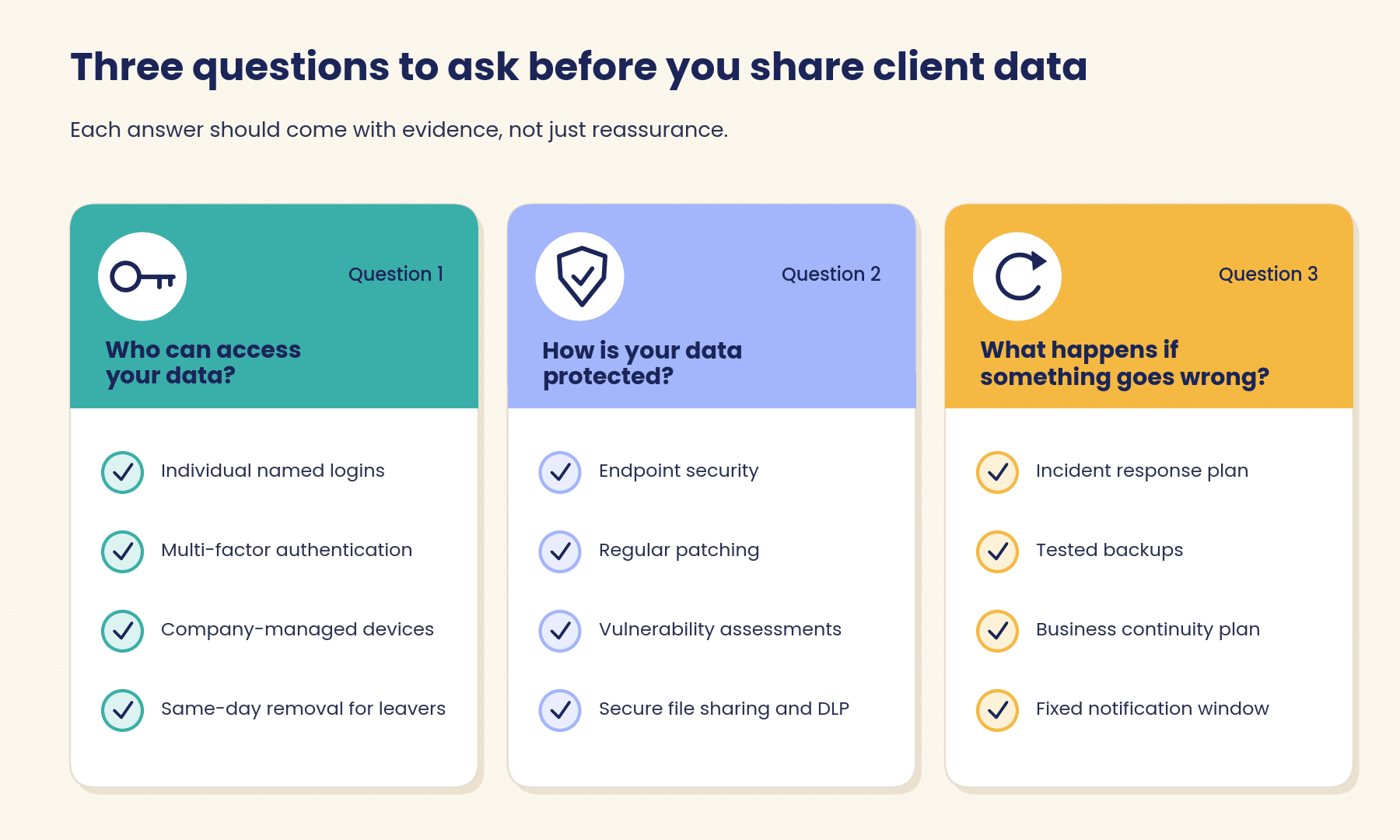
Step 1: Control who can access client data
Start with the most basic question: who can access your data? Many breaches trace back to access that was too broad, poorly protected or never revoked, so this is the foundation everything else rests on. Every person on the outsourced team should have their own named account, with permissions limited to the clients, folders and systems their role actually needs. Shared credentials, whether for practice software, a document portal or HMRC and ATO online services, have no place in a secure setup.
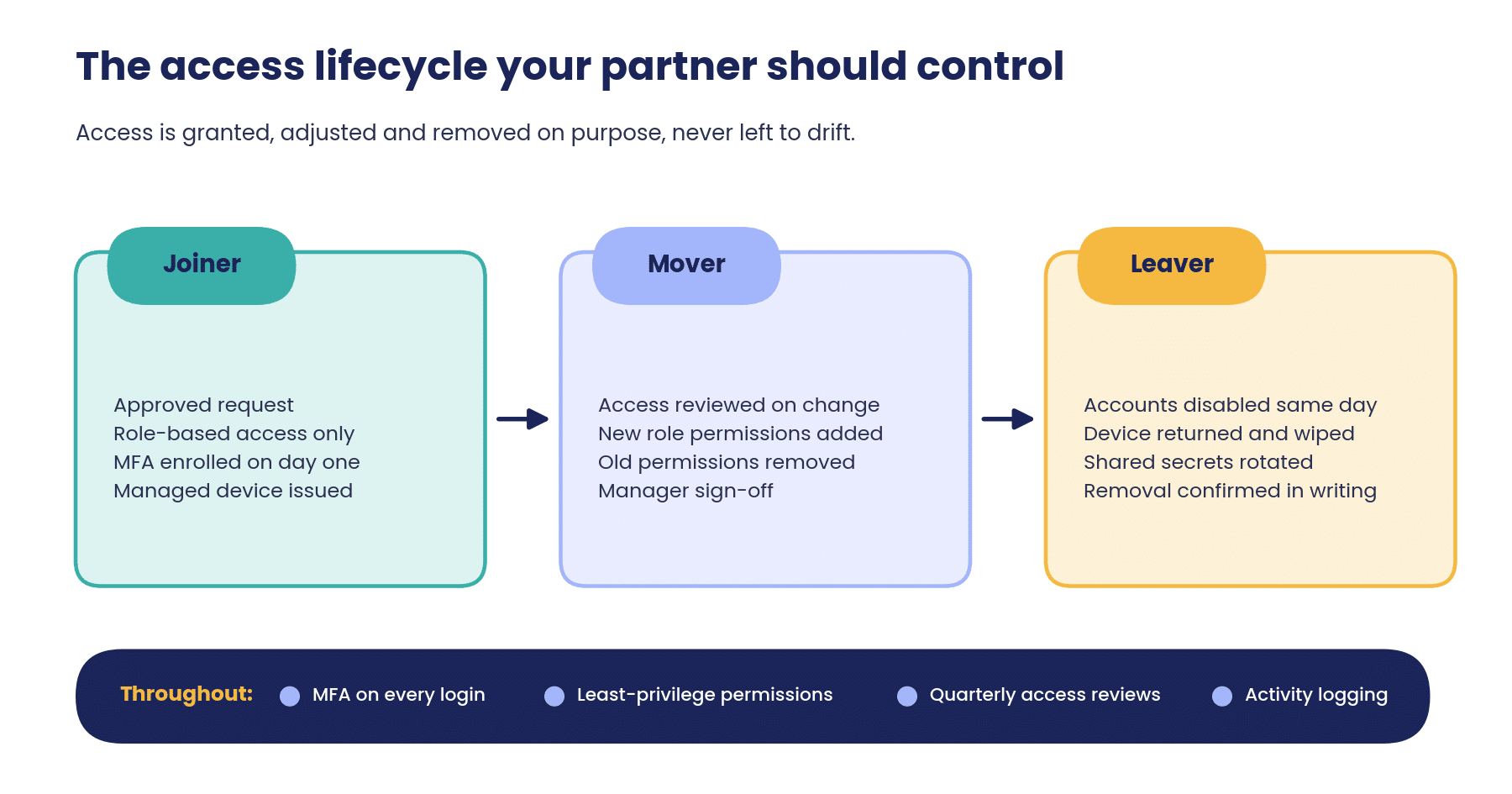
Multi-factor authentication should sit in front of every login, not only email. Work should be done on company-managed devices that the provider configures, encrypts and can wipe remotely, never on personal laptops or phones. Just as important is the exit: a written leaver procedure that removes access on the same day, supported by regular access reviews that catch permissions left behind when people change roles.
When you meet a prospective provider, ask how a new team member is given access, who signs it off and how quickly a leaver is removed from every system. Clear, confident answers here are a strong early signal, because accounting outsourcing data security begins with knowing exactly who holds the keys.
Step 2: Protect client data with layered security controls
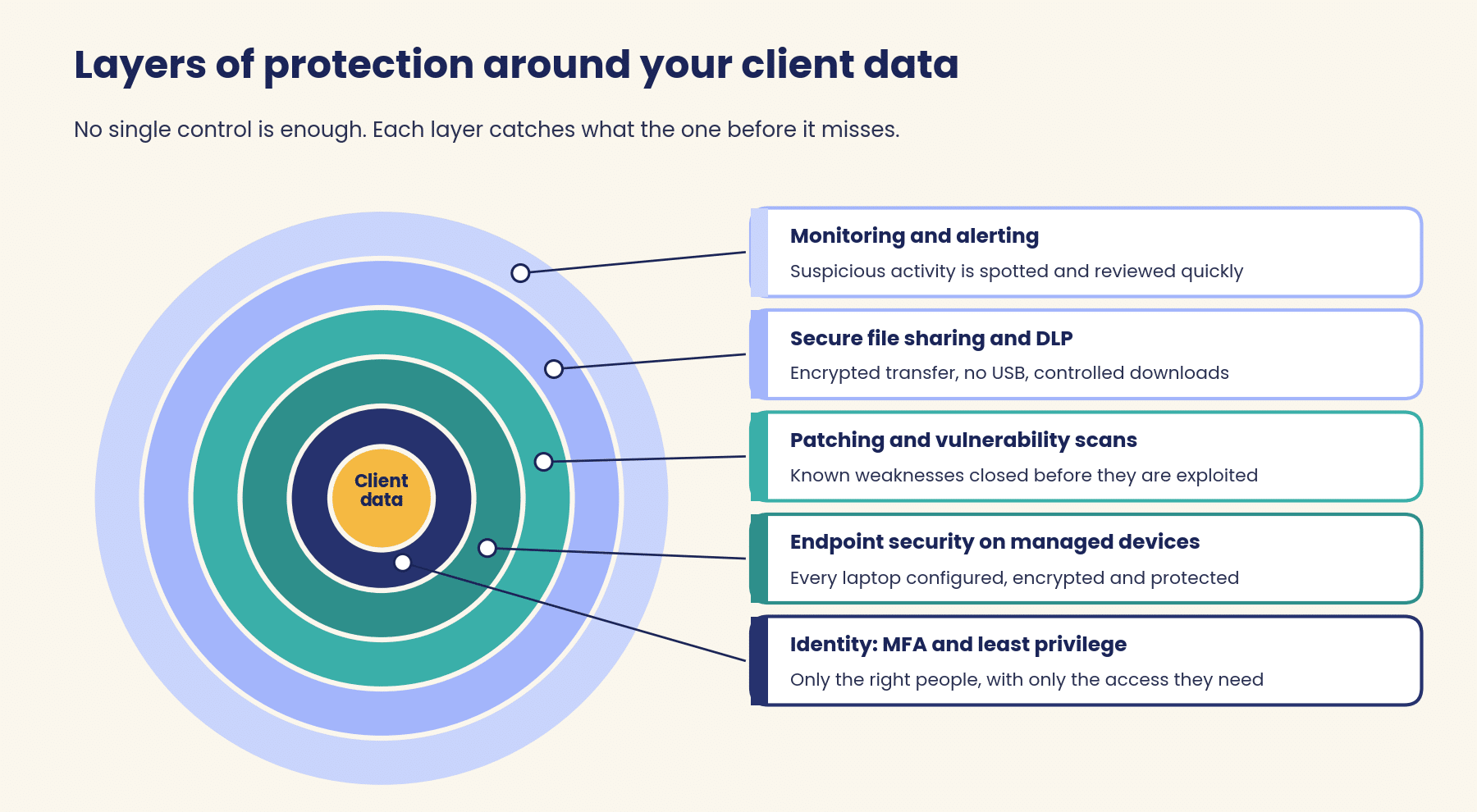
The second question is how your data is protected. No single tool does the job on its own, so look for layers that back each other up. Endpoint security on every device detects and stops malicious activity, while prompt, regular patching removes the known weaknesses attackers look for first. Vulnerability assessments, ideally supplemented by independent penetration testing, help the provider find and fix gaps before anyone else can exploit them.
File handling deserves the same scrutiny. Client documents should move through encrypted file-sharing platforms with permissions and audit trails, rather than as email attachments or through personal cloud accounts. Sensible data loss prevention controls, such as disabling USB storage, limiting downloads and printing, and alerting on unusual transfers, make it far harder for information to leave the environment, whether by mistake or on purpose.
If you practise in Australia, the Australian Signals Directorate's Essential Eight is a practical benchmark, and it's worth asking which maturity level a provider works towards. UK firms will find much of the same ground covered by the government-backed Cyber Essentials scheme. Here's how the controls above compare with both.
How these protections map to Essential Eight and Cyber Essentials
| Protection | What your provider should have | Essential Eight (Australia) | Cyber Essentials (UK) |
|---|---|---|---|
| Identity | MFA on every login and individual named accounts | Multi-factor authentication | User access control |
| Admin rights | Administrator access restricted, approved and reviewed | Restrict administrative privileges | User access control |
| Patching | Applications and operating systems updated promptly | Patch applications; patch operating systems | Security update management |
| Endpoints | Endpoint security and application control on managed devices | Application control; user application hardening | Malware protection |
| Configuration | Hardened device builds with macros restricted | Restrict Microsoft Office macros | Secure configuration |
| Network | Firewalls and secure remote access | Outside the Essential Eight | Firewalls |
| Backups | Regular backups with tested restores | Regular backups | Not covered: ask separately |
| File sharing and DLP | Encrypted file sharing and data loss prevention | Not covered: ask separately | Not covered: ask separately |
Treat both frameworks as a floor rather than a finish line. Neither directly addresses secure file sharing or data loss prevention, so raise those separately. For genuine accounting outsourcing data security, choose a provider that meets the baseline and can clearly explain the controls it adds on top, rather than one that simply points to a badge.
Step 3: Prepare for incidents, backups and business continuity
The third question is what happens if something goes wrong. No organisation can guarantee it will never have an incident; the difference lies in how ready it is. A dependable provider keeps documented incident response procedures that set out roles, classification, escalation and, crucially, how fast your firm will be informed. Writing a fixed notification window into your contract, such as 24 hours from discovery, keeps your own legal deadlines within reach.
Backups are only as good as the last successful restore, so ask when one was last tested and how long recovery took. A business continuity plan should explain how work carries on if an office, system or key supplier goes down, and it should be rehearsed at least once a year. Providers with more than one delivery centre can often keep work flowing when one site is disrupted, provided that switchover has been planned and practised
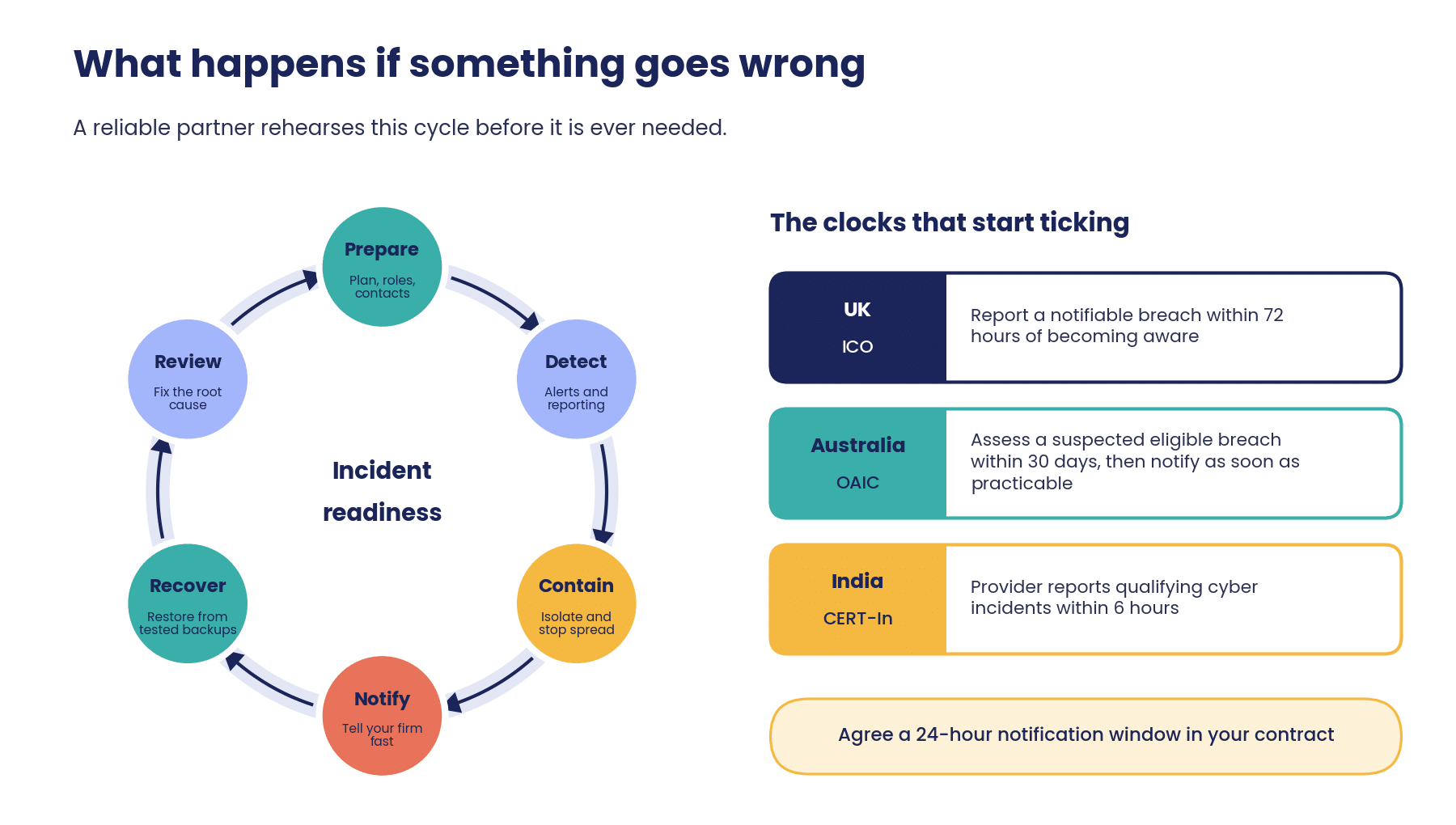
Your own reporting duties depend on your jurisdiction. In the UK, a notifiable personal data breach must reach the ICO within 72 hours of your becoming aware of it, under Article 33 of the UK GDPR. In Australia, organisations covered by the Privacy Act must assess a suspected eligible data breach within 30 days and, if it's confirmed, notify the OAIC and the individuals affected as soon as practicable under the Notifiable Data Breaches scheme. Indian providers must also report certain cyber incidents to CERT-In within six hours. Make sure your provider's process is built to support your deadlines, not only its own.
Accounting outsourcing data security rules in the UK and Australia
Technical controls only cover part of the picture. Before client information leaves your practice, you also need to consider the data protection laws, contractual obligations and international transfer requirements that apply to you. The specifics differ between the UK and Australia, yet the underlying principle is identical: your firm remains accountable for client data, even when another organisation processes it.
UK and Australian requirements side by side
| Requirement | Column 2 | Column 3 |
|---|---|---|
| Core law | UK GDPR and the Data Protection Act 2018 | Privacy Act 1988 and the Australian Privacy Principles (APPs) |
| Sending data overseas | India is a restricted transfer destination: use the IDTA or UK Addendum with a transfer risk assessment | APP 8: take reasonable steps so the overseas recipient handles data consistently with the APPs; you generally stay accountable for it |
| Security duty | Article 32: appropriate technical and organisational measures | APP 11: reasonable steps to protect personal information, including technical and organisational measures |
| Contract with your provider | An Article 28 data processing agreement | Contract terms that bind the provider to APP-consistent handling and security |
| Breach notification | Report notifiable breaches to the ICO within 72 hours of becoming aware | Assess suspected breaches within 30 days; notify the OAIC and affected individuals as soon as practicable if eligible |
| Professional duties | Confidentiality under the ICAEW and ACCA codes of ethics | TPB Code of Professional Conduct, including client permission before disclosing information to third parties |
Several recent developments are worth keeping on your radar. In Australia, the Privacy and Other Legislation Amendment Act 2024 reinforced APP 11 and expanded the regulator’s enforcement powers, and the Tax Practitioners Board expects registered agents to secure client permission before sharing client information with a third party, offshore providers included. Firms covered by the Privacy Act’s small business exemption are still bound by those TPB confidentiality obligations. In the UK, the Data (Use and Access) Act 2025 is reshaping parts of the international transfer regime, so review the ICO’s guidance on the International Data Transfer Agreement before you finalise your arrangements.
How to verify that your provider protects client data
A well-run provider will anticipate the request and respond promptly. Policies explain what is supposed to happen; records prove what actually does. Use the table below to decide what to ask for, what each item demonstrates and how current it ought to be.
Evidence to request from your outsourcing provider
| Evidence to request | What it proves | How recent it should be |
|---|---|---|
| ISO/IEC 27001 certificate and Statement of Applicability | An independent auditor has assessed the security management system | Current, on the 2022 version, with scope covering your team |
| Access review records | Permissions are checked, not assumed | Within the last quarter |
| Leaver process and a recent example | Access is removed promptly and completely | Within the last few months |
| Penetration test or vulnerability assessment summary | Weaknesses are actively looked for and fixed | Within the last 12 months |
| Column 1 Value 5 | Updates are applied consistently across devices | Within the last month |
| Column 1 Value 6 | The team knows what to do and has practised it | Tested within the last 12 months |
| Column 1 Value 7 | Data can actually be recovered | Within the last quarter |
| Column 1 Value 8 | Work can continue through disruption | Within the last 12 months |
| Column 1 Value 9 | Everyone understands their responsibilities | Annually, plus induction for new joiners |
| Column 1 Value 10 | Responsibilities are legally binding | Reviewed for your jurisdiction before signing |
Hesitation, a policy offered in place of a record, or a request to simply trust the team are all telling responses. Real accounting outsourcing data security can be checked on paper and seen in practice.
Why the right controls matter more than expensive tools
In our experience of working alongside practice partners, cybersecurity isn't about owning the most expensive tools. It's about putting the right controls in place, monitoring them consistently and making sure every person understands their part. A team with premium security software but a patchy leaver process is more exposed than one using modest tools that are well configured, reviewed every week and understood by everyone.
So the most useful questions are often about people and routines rather than products. How often is the team trained? Who reviews security alerts, and how quickly? What happens when someone reports a suspicious email? The answers reveal whether accounting outsourcing data security is part of everyday work or only part of the sales pitch.
How Virtual Clone protects client data
We apply the same standard to ourselves that we'd encourage you to apply to any provider. Virtual Clone holds ISO 27001 and ISO 9001 certification, and as an ACCA Approved Employer we invest in developing the people who work on your clients' files. Our delivery centres in Nagpur and Mumbai support accounting practices across the UK, Australia and Europe.
When a firm evaluates us, we're glad to work through each of these steps in detail and share the evidence behind our answers. For us, that transparency is part of earning your trust, not an extra stage in the sales process.
Frequently asked questions
What security controls should an accounting outsourcing provider have?
As a minimum, look for individual logins with multi-factor authentication, least-privilege access, company-managed devices, endpoint security, regular patching, vulnerability assessments, secure file sharing, data loss prevention, documented incident response, tested backups and a business continuity plan, backed by current ISO/IEC 27001 certification.
Is it safe for UK and Australian accounting firms to outsource to India?
Yes, provided the provider can evidence strong security controls and your firm meets its data protection obligations. UK firms need a lawful transfer mechanism, such as the IDTA or UK Addendum, together with an Article 28 processing agreement. Australian firms must take reasonable steps under APP 8 to ensure the overseas recipient handles personal information in line with the Australian Privacy Principles.
How do UK GDPR and the Australian Privacy Act apply to outsourced accounting?
Both keep your firm accountable for client data when a provider processes it. Under UK GDPR you need an Article 28 processing agreement, appropriate security under Article 32 and a lawful mechanism for transfers to India. Under the Privacy Act, APP 8 governs disclosure to overseas recipients and APP 11 requires reasonable steps to secure personal information.
Who is responsible if an outsourcing provider suffers a data breach?
Your firm generally stays accountable to clients and regulators. In the UK you remain the data controller, and in Australia you can be held responsible for how an overseas recipient handles information you disclosed. Your contract should spell out the provider's obligations, notification timelines, liability and insurance.
How quickly must a data breach be reported in the UK and Australia?
In the UK, notifiable breaches must be reported to the ICO within 72 hours of becoming aware of them. In Australia, a suspected eligible data breach must be assessed within 30 days, and confirmed eligible breaches must be notified to the OAIC and affected individuals as soon as practicable.
What evidence should we ask an outsourcing provider for to prove data security?
Request a current ISO/IEC 27001 certificate and Statement of Applicability, recent access review records, a penetration test summary, patch compliance reports, an incident response plan with test records, backup restore tests, business continuity test results and staff security training records.
Do we need client permission to outsource work offshore?
In Australia, the Tax Practitioners Board expects registered tax agents to obtain client permission before disclosing client information to a third party, including an offshore provider. In the UK, your privacy notice should explain any overseas processing, and many firms also address outsourcing in their engagement letters
Accounting outsourcing data security starts with the right provider
As a partner, choosing who handles your clients' information is one of the most significant trust decisions you will make for your firm. By controlling access, layering your defences and preparing for the unexpected, and by asking for evidence at every step, you can protect client data with confidence and tell genuine security apart from well-crafted promises.
Protecting data is not an additional service. It is a fundamental responsibility of every outsourcing provider.
Ready to put us to the test? Talk to our team and we'll take you through each step, with the evidence to support our answers. UK firms may also want to read our due diligence checklist for data protection and access control.
