

A practical playbook for recruitment teams that need to reduce time-to-hire and still bring in people who perform, stay and fit the team.
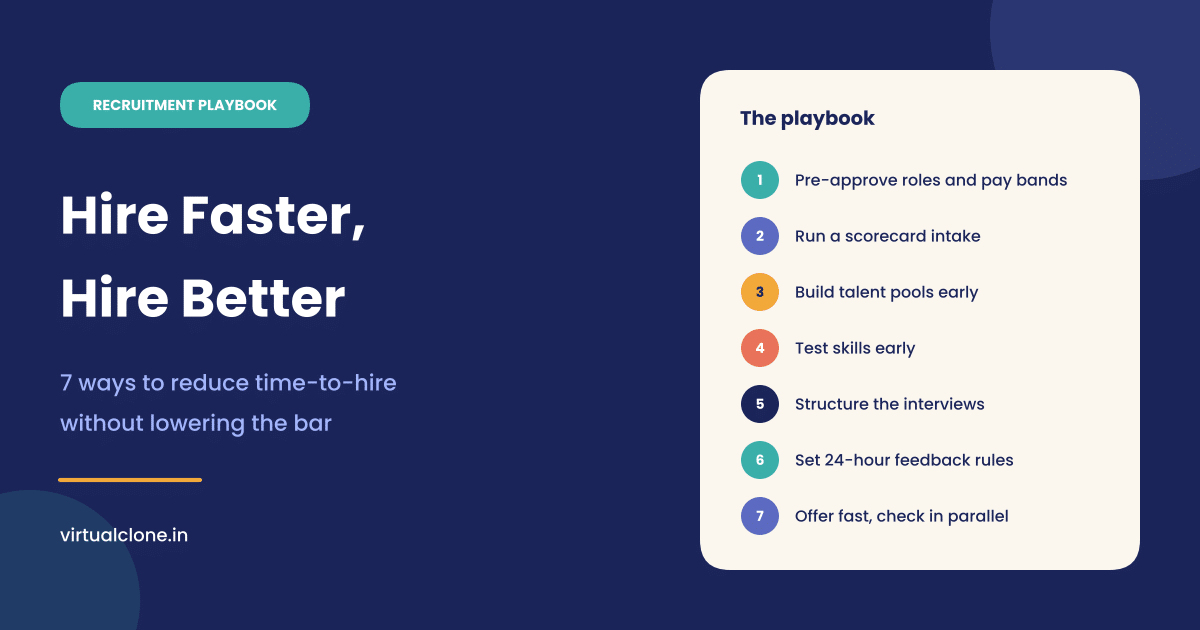





Every recruiter knows the feeling. You find a strong candidate, the hiring manager is enthusiastic, and then the process stalls: a second interviewer is on leave, feedback sits in someone's inbox for a week, the offer needs one more sign-off. By the time you call with good news, the candidate has accepted something else.
In competitive markets, and accounting and finance roles across the UK, Australia and Europe certainly qualify, the best candidates are rarely available for long. A slow process doesn't just cost days. It quietly filters out the people with the most options, which is the opposite of what any recruitment team wants.
The good news is that most of the delay in a typical hiring process isn't assessment at all. It's waiting. In this playbook we'll show you where the days go, seven practical levers to reduce time-to-hire, and the quality measures that prove you haven't lowered the bar to get there.
How can recruitment teams reduce time-to-hire without compromising candidate quality?
By cutting the time candidates spend waiting rather than the time spent assessing them. In most hiring processes, the slowest stages are approvals, scheduling and feedback, not the interviews or tests themselves. Removing that idle time makes the process faster and, because decisions are made while the evidence is fresh and candidates are still engaged, it often makes it better too.
The approach has three parts. First, do the slow thinking before the vacancy opens: agree the role, the pay and what good looks like. Second, assess in fewer, better-structured steps, using job-relevant skills tests and structured interviews. Third, set clear service levels for feedback and offers, and measure quality of hire afterwards so that speed never becomes the only goal.
Time-to-hire, time-to-fill and time-to-start: what's the difference?
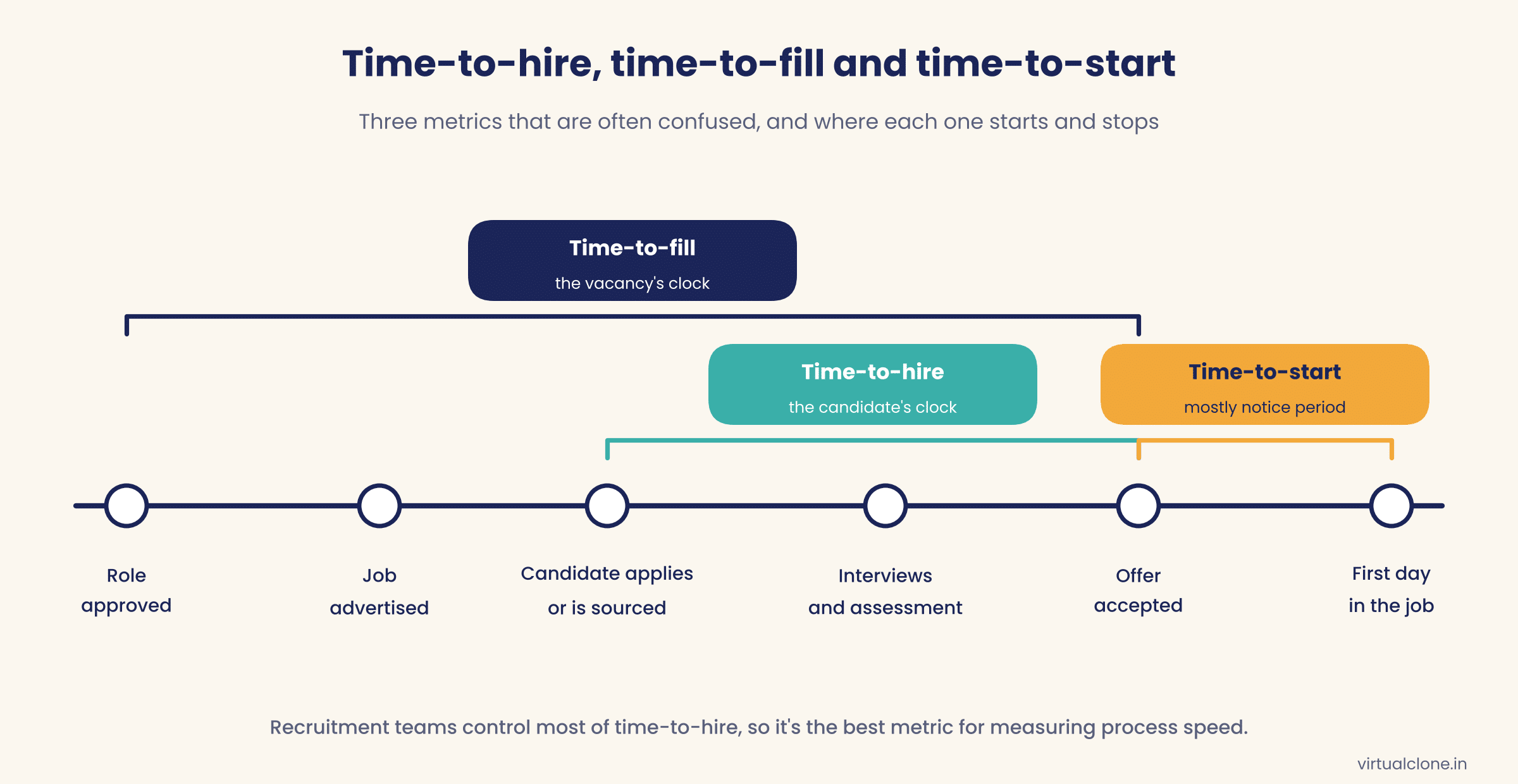
Before you try to improve the number, make sure everyone means the same thing by it. Three metrics are often used interchangeably, and mixing them up makes progress hard to see.
| Metric | Starts when | Ends when | Best used for |
|---|---|---|---|
| Time-to-hire | A candidate applies or is sourced | The candidate accepts the offer | Measuring how efficient your process is for candidates |
| Time-to-fill | The role is approved or opened | An offer is accepted | Workforce planning and hiring manager expectations |
| Time-to-start | An offer is accepted | The new hire’s first day | Planning onboarding around notice periods |
Recruitment teams have the most control over time-to-hire, so it's the best measure of process efficiency. Time-to-start is mostly notice period, often one to three months for experienced finance professionals in the UK, so it needs a plan of its own: keeping your new hire engaged until day one.
Where the days actually go
When teams map their process stage by stage, the result is usually a surprise. The illustrative example below shows a 45-day journey for an experienced finance role, from approval to accepted offer. The interviews and assessments themselves take up only a few hours of anyone's time, yet the stages around them stretch across weeks.
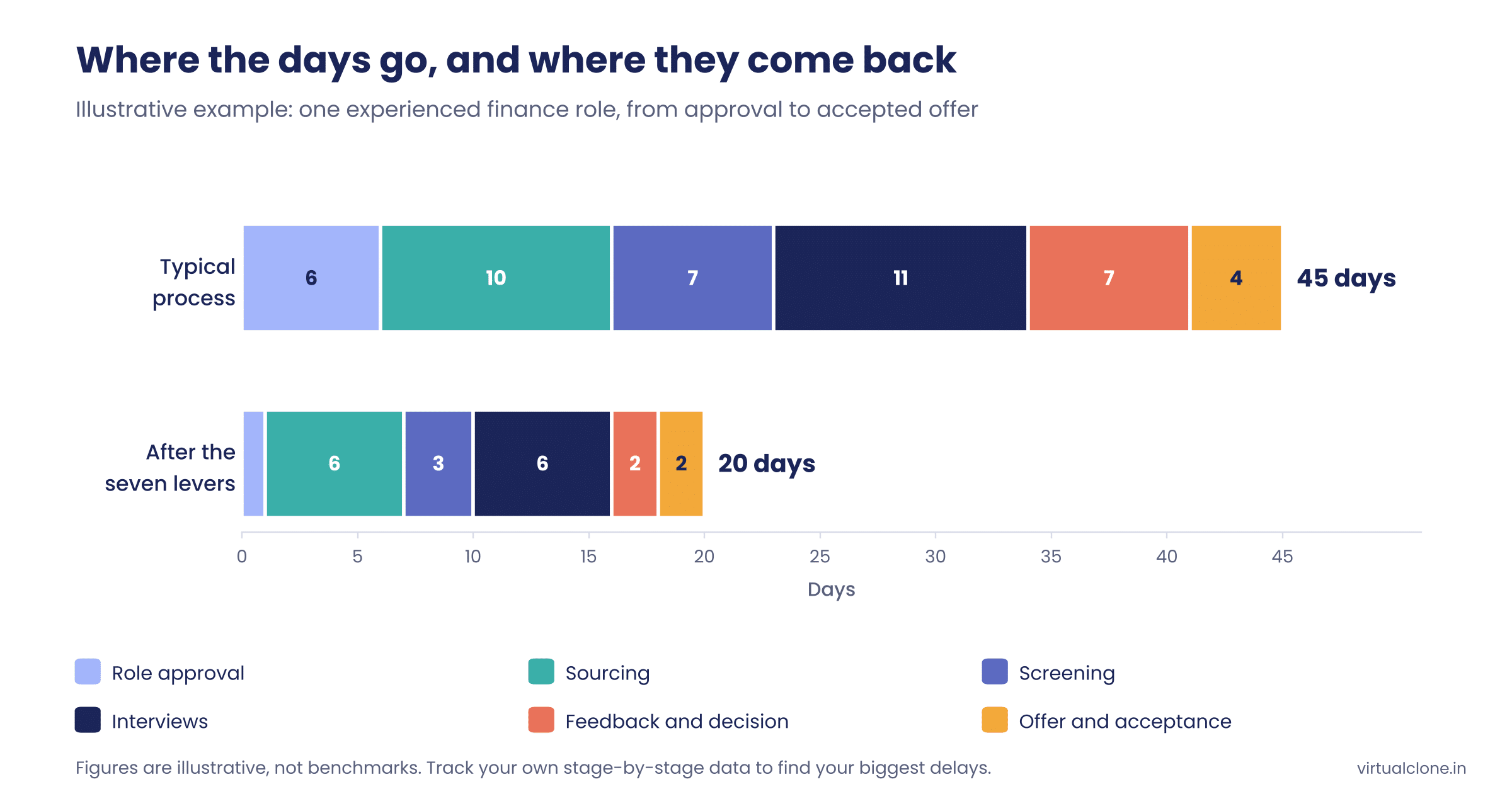
Your numbers will differ, which is exactly why it's worth measuring them. Pull the dates from your applicant tracking system for your last ten or twenty hires, split the journey into stages and find the two longest waits. Those are where the seven levers below will do the most good.
Seven ways to reduce time-to-hire without lowering the bar
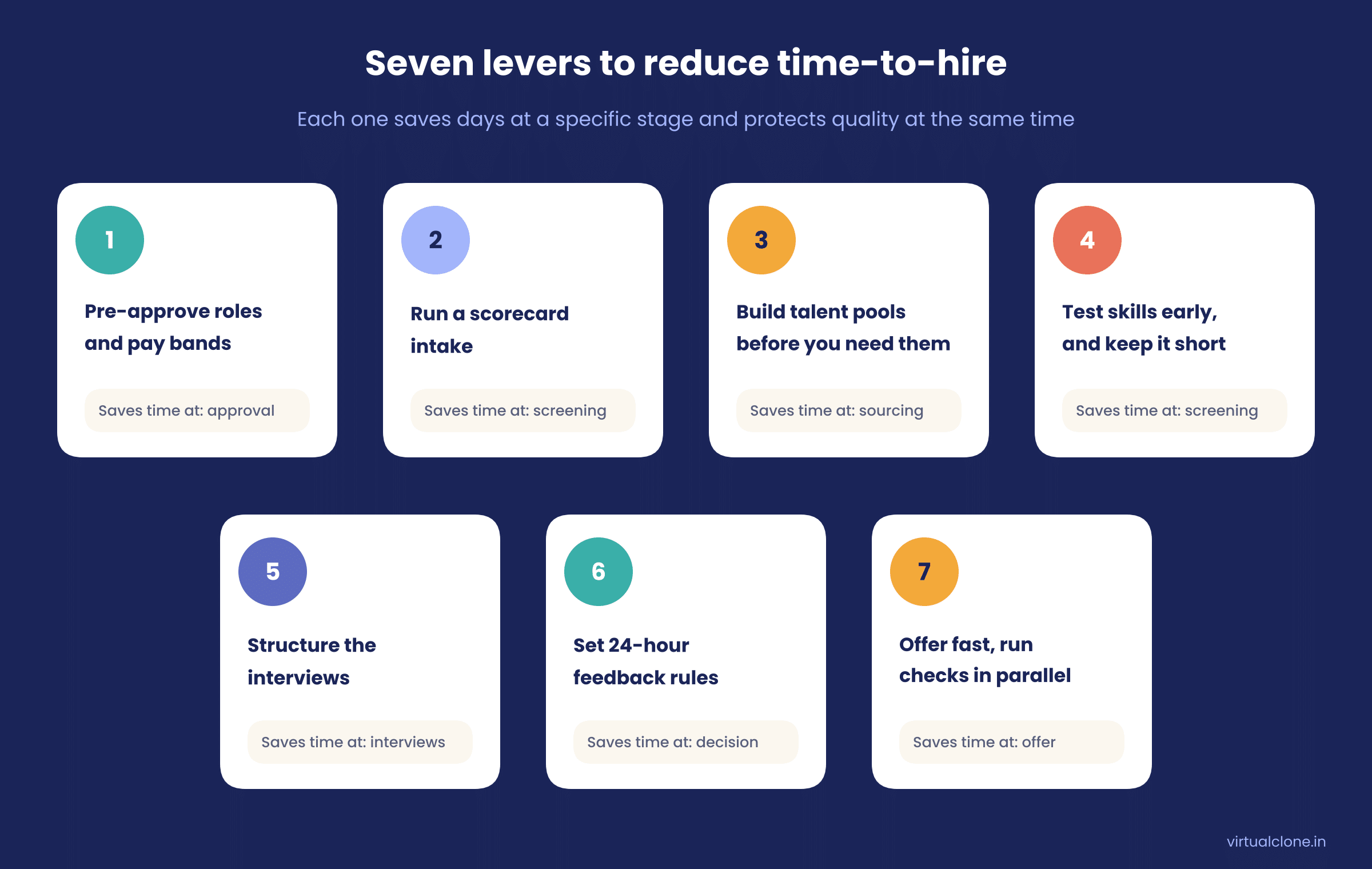
These are the levers we see work most reliably. Each one targets a specific stage of the process and protects quality at the same time, so you don't have to choose between the two. Start with the levers aimed at your two longest waits.
| Lever | Speeds Up | How it protects quality | Effort to set up | |
|---|---|---|---|---|
| 1 | Pre-approve roles and pay bands | Approval | Pay is set against the market, not negotiated in a rush | Medium |
| 2 | Run a scorecard intake | Screening | Everyone assesses against the same must-haves | Low |
| 3 | Build talent pools early | Sourcing | You start with pre-qualified, engaged people | Medium |
| 4 | Test skills early | Screening | Decisions rest on evidence of ability, not CV polish | Low |
| 5 | Structure the interviews | Interviews | Consistent questions predict performance better | Medium |
| 6 | Set 24-hour feedback rules | Decision | Evidence is judged while it’s fresh | Low |
| 7 | Offer fast, check in parallel | Offer | Checks still happen, just not one after another | Low |
1. Pre-approve roles and pay bands
Approval delays are the most avoidable wait in recruitment. If your workforce plan says the finance team will need two more payroll specialists in the spring, approve the headcount, the job description and the salary band now. When the vacancy opens, the recruiter can start sourcing the same day rather than waiting a week for sign-off.
Pre-approved bands protect quality too. Offers built on market data rather than last-minute haggling are more likely to be accepted and less likely to unravel at the counter-offer stage. If you recruit in the EU, the Pay Transparency Directive requires employers to tell applicants the pay range before the interview, so agreeing bands early is fast becoming a requirement rather than a nice-to-have as member states bring it into national law.
2. Run a scorecard intake with the hiring manager
A 30-minute intake meeting within 48 hours of approval saves days later. Agree four to six must-have criteria, the nice-to-haves, the interview stages and who's involved, and write them down as a scorecard. For an accounts semi-senior, that might mean confident use of Xero or Sage, experience preparing VAT returns, accuracy under deadline pressure and clear client communication.
The scorecard is the single most important quality safeguard in a faster process. It stops the brief from changing halfway through, gives screeners a clear test to apply and keeps every later conversation focused on evidence rather than gut feel.
3. Build talent pools before you need them
The fastest hire is someone you already know. Keep in touch with strong runners-up from previous campaigns, former employees who left on good terms, referrals and candidates who weren't quite ready a year ago. For recurring roles such as bookkeepers, payroll administrators and audit trainees, an engaged pool can turn a three-week sourcing exercise into a few phone calls.
Referral programmes deserve special attention. Referred candidates arrive with a degree of screening already done by someone who knows both the person and the job, which is why so many recruitment teams treat referrals as one of their strongest sources.
4. Test skills early, and keep it short
Move a short, job-relevant assessment to the front of the process instead of the end. A 30 to 45-minute task, such as reconciling a sample bank statement or reviewing a VAT return with a few deliberate errors, tells you more than a CV ever will, and it lets you shortlist on evidence within days.
Keep it proportionate. Long, unpaid take-home projects deter strong candidates who have other options, which defeats the purpose. If you use AI tools to help screen applications, keep a person accountable for every decision and ask how the tool was tested for bias. The UK's Information Commissioner's Office has published recommendations on AI in recruitment, and the EU AI Act treats AI systems used for recruitment as high-risk.
5. Structure the interviews, in three stages or fewer
Every extra round adds days of scheduling and another chance to lose the candidate. Most professional roles can be assessed well in two or three stages: a short screening call, a skills or technical interview, and a final conversation about values and ways of working. Combine panels into a single session where you can, and ask interviewers to block regular interview slots in their diaries, so scheduling becomes a matter of picking a time rather than finding one.
Structure is what keeps quality high as the stages shrink. Ask every candidate the same core questions, linked to the scorecard, and rate answers against agreed criteria. Decades of research on selection methods consistently find that structured interviews predict job performance better than unstructured conversations, and they're fairer to candidates too.
6. Set 24-hour feedback and decision rules
Slow feedback is the silent killer of a good hiring process. Agree service levels up front: interviewers submit written scorecards within 24 hours, the hiring manager decides on the day of the final interview and the recruiter updates every candidate at least weekly. The framework below is a simple starting point you can adapt.
| Stage | Owner | Target turnaround |
|---|---|---|
| Intake meeting | Recruiter and hiring manager | Within 48 hours of approval |
| Shortlist review | Hiring manager | Within 24 hours of receiving CVs |
| Interview feedback | Each interviewer | Within 24 hours, before any group discussion |
| Hiring decision | Hiring manager | Same day as the final interview |
| Verbal offer | Recruiter | Within 24 hours of the decision |
| Candidate updates | Recruiter | At least once a week, even with no news |
Asking for independent written feedback before the group discussion has a quality benefit as well as a speed one. It reduces the risk that the most senior or most confident voice in the room sways everyone else.
7. Make the offer fast and run checks in parallel
Once you've decided, move quickly. Call with a verbal offer within a day, follow up with the written offer straight away and start references, qualification checks and right-to-work checks at the same time rather than one after another. In the UK, right-to-work checks must be completed before employment starts, so building them into the offer stage avoids a last-minute scramble.
Then plan for the notice period. Keep in regular contact, invite your new hire to meet the team, share onboarding information early and make sure their equipment and access are ready for day one. Candidates who already feel part of the team before they start are less likely to be tempted by a counter-offer.
Speed traps: shortcuts that quietly damage quality
Not every way to reduce time-to-hire is a good one. Some shortcuts save a few days now and cost far more later in mis-hires, early leavers and repeat recruitment. The table below sets out the most common traps and the safer alternatives.
| Tempting shortcut | Why it backfires | Do this instead |
|---|---|---|
| ✖ Skipping references to save a week | Problems surface after the hire, not before | ✔ Run references in parallel with the offer |
| ✖ Dropping the skills test | You hire the best interviewee, not the best accountant | ✔ Shorten the test to 30–45 minutes |
| ✖ One interviewer making the call alone | One person’s blind spots go unchecked | ✔ A structured panel in a single session |
| ✖ Relaxing must-haves under pressure | Gaps show up within months | ✔ Separate must-haves from nice-to-haves at intake |
| ✖ Exploding offers with tight deadlines | Pressured candidates renege or leave early | ✔ Fast, fair offers within pre-approved bands |
| ✖ Vague adverts to attract more applicants | More screening, weaker matches | ✔ A specific advert with a salary range |
How to prove quality hasn't slipped
Speed only counts if the people you hire succeed. As you reduce time-to-hire, pair your speed target with a small set of quality-of-hire measures and review them together every quarter. If time-to-hire falls while these hold steady or improve, you've genuinely got better. If they start to dip, you'll know which lever to revisit.
| Quality measure | How to track it | Warning sign |
|---|---|---|
| Hiring manager satisfaction | A short survey at 30 and 90 days | Scores falling as speed improves |
| 90-day retention | Leavers within the first three months | More early leavers than before |
| Time to productivity | Weeks until the new hire works independently | Ramp-up taking longer |
| Offer acceptance rate | Offers accepted divided by offers made | Candidates declining at the final stage |
| Candidate experience | A brief survey for every finalist | Complaints about communication or delays |
| First-year performance | Review ratings for new hires | A higher share of underperformers |
How to reduce time-to-hire for accounting and finance roles
Accounting and finance hiring has its own rhythm, and the seven levers work best when they follow it. Three adjustments make the biggest difference for accounting practices and finance teams.
Hire before the busy season, not during it. In the UK, the 31 January Self Assessment deadline makes December and January the worst time to interview, because reviewers have no spare hours. In Australia, the same squeeze arrives during tax time, from July to October. Open recurring roles early enough that new starters are trained before the peak.
Test the software and the standard, not just the CV. A short practical in the software your team uses, such as Xero, QuickBooks, Sage or IRIS, built around a real task like a bank reconciliation or a VAT return review, shows within an hour whether a candidate can do the work. For qualified roles, confirm membership with the professional body, such as ACCA, ICAEW or CA ANZ, while the offer is being prepared rather than after it.
Plan around notice periods. Experienced accountants often have one to three months' notice, so time-to-start can be longer than the whole hiring process. Agree a start date at offer stage, keep in touch every week and line up training so the first month is productive.
When the bottleneck is capacity, not process
Sometimes the process is sound and the problem is simply volume. A small in-house team juggling a dozen live vacancies can't run talent pools, same-day screening and weekly candidate updates for every role, however good its intentions. That's where extra capacity helps.
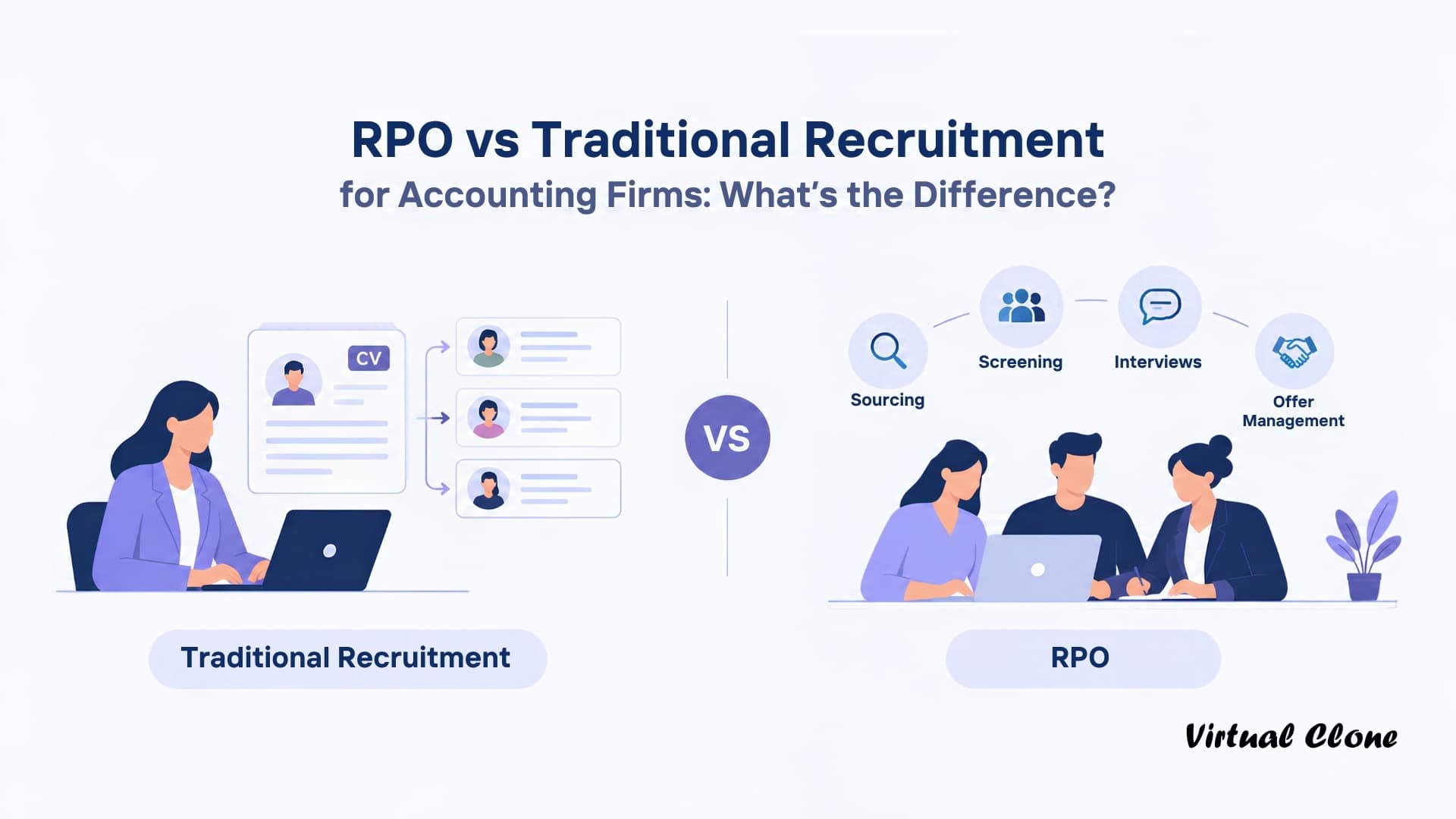
Recruitment process outsourcing (RPO) adds dedicated sourcing, screening and coordination support that works inside your process, so the levers above keep running even in your busiest periods. For some roles, it also makes sense to widen the talent pool beyond your local market, for example by building a dedicated offshore team for recurring accounting and finance work. Our guide to RPO versus traditional recruitment for accounting firms explains how the models compare and how firms use them to reduce time-to-hire during periods of growth. You can also see how Virtual Clone's recruitment process outsourcing services support UK and Australian firms.
Frequently asked questions
What is a good time-to-hire?
There's no universal number, because it depends on the role, seniority and market. Rather than chase an external benchmark, track your own time-to-hire by role family and aim to improve it quarter by quarter. Many teams aim to keep the active process, from first contact to accepted offer, within three to four weeks for experienced professional roles.
What's the difference between time-to-hire and time-to-fill?
Time-to-hire runs from the moment a candidate applies or is sourced until they accept an offer. Time-to-fill runs from the moment a role is approved or opened until an offer is accepted. Time-to-hire measures how efficient your process is; time-to-fill measures how long the business waits for the seat to be filled.
Does a faster hiring process lower candidate quality?
Not when the time saved comes from waiting rather than assessment. Removing approval delays, scheduling gaps and slow feedback usually improves quality, because strong candidates stay in the process and decisions are made while the evidence is fresh. Quality suffers when teams cut the assessment itself, such as skipping skills tests or references.
Can AI help reduce time-to-hire?
Yes, especially for scheduling, sourcing searches, drafting job adverts and organising applications. Keep people accountable for shortlisting and hiring decisions, check tools for bias and make sure your use complies with data protection law. The EU AI Act classes AI systems used in recruitment as high-risk.
How do you measure quality of hire?
Combine a few measures rather than relying on one: hiring manager satisfaction at 30 and 90 days, 90-day retention, time to productivity and first-year performance. Review them alongside time-to-hire every quarter so you can see whether speed and quality are moving together.
How can RPO help reduce time-to-hire?
Recruitment process outsourcing adds dedicated capacity for sourcing, screening, scheduling and candidate communication, so vacancies don't queue behind each other when your in-house team is stretched. A good RPO partner works to your scorecards and service levels, which keeps quality consistent while volume rises.
Should an accounting firm use RPO or a recruitment agency?
Choose according to the hiring need. A traditional recruitment agency is often suitable when you need help filling a specific vacancy, with the recruiter sourcing candidates for that placement. RPO is generally better when recruitment is ongoing, hiring volumes fluctuate or you need dedicated support across stages such as sourcing, screening, scheduling and candidate communication. An accounting firm should compare expected hiring volume, role mix, internal capacity, required control and total cost before choosing.
How can UK accounting firms solve the accountant shortage?
UK accounting firms can respond by combining better workforce planning, improved retention and access to additional talent. Recruitment process outsourcing can add sourcing and screening capacity, while a dedicated offshore team can provide ongoing support for recurring accounting work such as bookkeeping, payroll, VAT and year-end tasks. The right approach depends on which work can be delegated, the firm's systems and review processes, and the level of control it wants to retain. Virtual Clone supports accounting firms with dedicated professionals from its Bhilai, Mumbai and Nagpur delivery centres.
Faster and better aren't opposites
The fastest recruitment teams aren't the ones that cut corners. They're the ones that do the slow thinking early, assess in fewer and better steps, and refuse to leave candidates waiting. Pick the two longest waits in your current process, apply the matching levers and track quality of hire alongside speed. Within a quarter, you'll know exactly what's working.
At Virtual Clone, we help accounting firms across the UK, Australia and Europe build teams with dedicated professionals from our delivery centres in Bhilai, Mumbai and Nagpur. We're ISO 27001 and ISO 9001 certified and an ACCA Approved Employer. If you're planning to grow your team and want to reduce time-to-hire for recurring accounting roles, our recruitment process outsourcing team and dedicated offshore professionals can help, and we'd be glad to talk it through.