

For most UK accounting firms, the mechanics of Making Tax Digital for Income Tax are no longer the open question. The £50,000 cohort is live, quarterly submissions are underway, and the next two thresholds are already fixed in HMRC’s rollout calendar. What’s less settled — even inside firms that consider themselves ready — is what MTD actually changes about how a practice runs: its margins, its staffing model, its risk register and, for firms willing to use it as one, its relationship with clients.
This isn’t another rundown of who qualifies and when. It’s a look at the decisions that separate firms treating MTD as a compliance cost from firms using it to reposition the practice.
At a Glance
- The £50,000 cohort is live now; £30,000 follows in April 2027; £20,000 in April 2028 — each cohort differs in risk and margin profile, not just start date.
- Penalty exposure is points-based and scales with filing frequency; the useful firm-level signal is portfolio-wide clustering, not individual client cases.
- Bridging software has no regulatory expiry date; the case against relying on it long-term is operational, not compliance-driven.
- Quarterly cadence is a staffing-model problem as much as a software one — headcount fixed to your busiest quarter carries cost the rest of the year.
- Firms getting the most from MTD are using each quarterly update as an advisory conversation, not just a filing.
The Rollout Timetable Is a Segmentation Clock, Not a Calendar Reminder
The three-tier threshold schedule is settled and well known:
Tax Year |
Qualifying Income |
Mandatory From |
Status |
|---|---|---|---|
| 2026/27 | Over £50,000 | 6 April 2026 | Live |
| 2027/28 | Over £30,000 | 6 April 2027 | Confirmed |
| 2028/29 | Over £20,000 | 6 April 2028 | Confirmed |
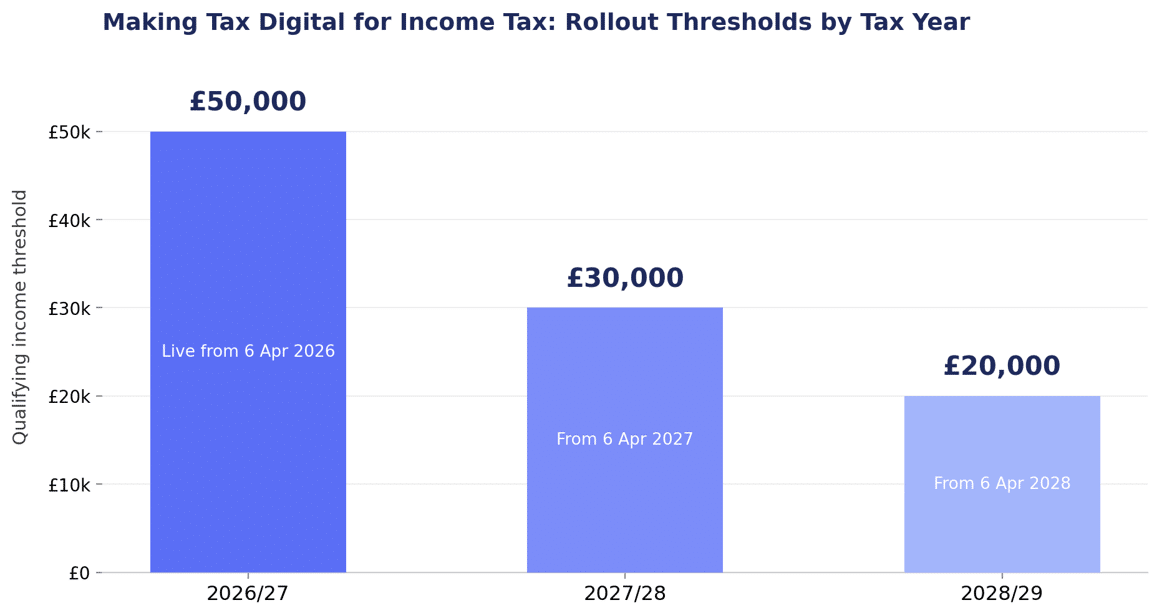
Framed only as a compliance calendar, the natural question is who’s in scope and by when — most firms resolved that months ago for the current cohort. Framed as a segmentation clock, the more useful question is how the next cohort differs from the one already live, while there’s still runway to act on it.
The £30,000 cohort arriving in April 2027 isn’t simply a lower-income version of the £50,000 cohort already in scope. On balance, it carries thinner margins per client, a higher proportion of part-digital or spreadsheet-based bookkeeping, and — perhaps counter-intuitively — clients who are more dependent on their accountant for basic digital process than for accounting judgement. The 2028 cohort at £20,000 extends this further. HMRC hasn’t ruled out taking the regime below £20,000 in future years, though no further threshold or date has been confirmed, which is itself worth building into any three-year capacity plan.
Segmenting purely by threshold tier, without a second axis for digital maturity and client profitability, is why some firms that considered themselves ready for the first cohort found the transition costlier than budgeted — the clients requiring the least accounting judgement are often the ones requiring the most hands-on onboarding.
Modelling Penalty Risk at Portfolio Level, Not Client by Client
Most commentary on MTD penalties treats it as a client-by-client compliance matter: a taxpayer misses a quarterly update, a taxpayer picks up a point. For a firm managing a large MTD-scope book, the more useful lens is portfolio-level. The points-based regime — built on the same framework HMRC introduced for VAT — scales the point threshold to submission frequency and resets after a sustained compliance record, sitting alongside a separate, escalating late-payment penalty and interest regime that runs independently of submission points.
The meaningful figure for a firm’s own risk register isn’t any single client’s point total. It’s the proportion of the MTD-scope book showing point accumulation within the same rolling period. Clustering across multiple, otherwise unrelated clients is a far earlier warning sign of an internal bottleneck — an intake process, a review-capacity gap, a software integration failing silently for a subset of clients — than any individual late submission suggests on its own. Worth a standing slot on the practice risk register, reviewed alongside the submissions themselves, rather than something that only surfaces when a client queries a penalty notice.
Software Compatibility Is a Stack Decision, Not a Per-Client Checklist
Handled client by client, software compatibility becomes an accumulating liability: a slightly different platform or bridging tool for each client, each with its own support quirks, exception patterns and staff training requirement. Handled as a stack decision, it’s a small, deliberate set of approved platforms the practice actively supports, a bridging-software policy for legacy clients with an explicit — if generous — migration horizon, and negotiated firm-wide terms with one or two vendors rather than a patchwork of individual client subscriptions.
This matters more than it did under annual Self Assessment, because quarterly cadence multiplies submission volume across the year rather than concentrating it into a single event — a fragmented technology stack that was merely inconvenient once a year becomes a live operational drag four times over. HMRC’s rules place no expiry date on bridging software as a compliant route; the case against leaning on it indefinitely is operational rather than regulatory. It adds a point of failure and a support burden that tends to compound faster than the licence saving justifies, particularly for clients whose affairs are growing in complexity.
Why Quarterly Cadence Rewrites the Staffing Calculus
Self Assessment created one predictable annual peak. MTD for Income Tax doesn’t just add three more — it raises total annual submission volume across a book considerably, even though each individual quarterly update requires less work than a full return. The net effect is a flatter total-effort curve but a sharply higher frequency of client-facing coordination: chasing records, reviewing entries, catching exceptions, resolving queries, four times a year instead of once.
Firms that respond by permanently staffing to their busiest quarter carry expensive idle capacity the rest of the year. Firms that try to absorb it into existing headcount risk exactly the kind of review shortcuts that show up as the point-accumulation pattern described above. The middle path most firms are landing on is a blended delivery model: a smaller core in-house team holding partner-level review and client relationships, supported by elastic capacity that flexes to the quarterly cycle rather than being fixed to it.
This is the staffing model behind our own quarterly delivery work for client practices. Operating as an ACCA Approved Employer under ISO 27001 and ISO 9001, the audit-ready, quarterly-cadence discipline MTD now asks of every practice is close to how we’re built to work by default.
The Real Opportunity: Turning a Filing Deadline Into an Advisory Touchpoint
The strategic upside in MTD is easy to miss underneath the compliance workload, but it’s real: the regime manufactures four built-in client conversations a year where, for most clients, there used to be one — an annual return meeting that was often rushed and entirely backward-looking. Each quarterly update is a natural opening for a short, forward-looking check-in: a cash flow flag, a tax-payment planning nudge, an early read on a seasonal trend — the kind of near-real-time commentary that, until now, only clients paying for a separate management-accounts service typically received.
Firms that redesign the quarterly submission into a brief advisory conversation, even fifteen minutes, rather than a pure data hand-off, build a natural path into higher-margin advisory retainers. They’re also the firms best placed to pick up clients transferring away from practices that never got past treating MTD as a cost to be minimised.
The thresholds and deadlines were always going to arrive on schedule; that part of MTD for Income Tax was never really in question. What’s still being decided, firm by firm, is whether the transition gets treated as a compliance cost to absorb or a capacity, margin and advisory decision worth making deliberately. The firms approaching it as the latter are the ones setting themselves up to look meaningfully different — to clients, and to prospective hires — three rollout cohorts from now.
Frequently Asked Questions
Is MTD penalty risk assessed per client or across a firm’s whole book?
Per individual taxpayer record — points and financial penalties attach to the taxpayer, not the firm. In practice, a firm managing a large MTD-scope book should still watch it at book level: clustering of point accumulation across multiple clients in the same period usually signals an internal bottleneck rather than a run of unrelated client-side failures, and is worth surfacing to partners as a portfolio indicator rather than logging it client by client.
Is bridging software a permanent option, or only a stopgap?
HMRC’s rules place no fixed expiry date on bridging software — it remains a valid route to compliance for clients who keep records in spreadsheets and use it to transmit data to HMRC. The practical argument against relying on it long-term is operational rather than regulatory: it adds a point of failure and a support burden that tends to compound faster than the software cost falls, particularly as a client’s affairs grow more complex.
How does the 2028 threshold change client segmentation for firms already managing the £50,000 and £30,000 cohorts?
It meaningfully expands the in-scope population, and it disproportionately pulls in clients with the least existing digital infrastructure and the thinnest margins to absorb new compliance cost. That’s why segmentation by digital maturity — not just by income threshold — matters more for this cohort than for either of the first two.
Are any clients exempt from MTD for Income Tax altogether?
Yes. HMRC retains a “digitally excluded” exemption modelled on the equivalent VAT exemption, covering circumstances such as age, disability, remoteness from reliable internet access, or religious objection to using computers. It’s a narrow exemption that has to be applied for rather than assumed, but it’s worth identifying the small number of genuinely eligible clients in a book early, rather than defaulting everyone into a software onboarding process some of them don’t need.
With clients spread across different cohorts and quarter alignments, how should firms track deadlines without one date to work from?
There isn’t a single date that applies across a book, and treating it as though there is one is a common source of missed submissions. Each client’s quarterly deadline falls one calendar month after their quarterly period ends, and that period depends on whether they’re using HMRC’s standard tax-year-aligned quarters or have elected calendar-quarter alignment. Most firms solve this with a single internal reporting calendar, mapped once per client at onboarding, rather than tracking each deadline individually as it approaches.