

When we talk with accounting firm leaders across the UK, Australia, and the EU, one thing keeps surfacing in almost every conversation: hybrid work is no longer a temporary accommodation. It is the operating model firms are quietly building their whole talent strategy around. That shift is forcing recruitment process outsourcing to move just as fast. Remote-First Recruitment has gone from a nice-to-have add-on to the default lens through which forward-looking RPO partners now source, screen, and place accounting professionals.
This matters because accounting has its own particular talent pressures. Client deadlines do not pause for a hiring freeze, qualified candidates are harder to find than they were five years ago, and the profession’s own workforce data has been signalling a shrinking graduate pipeline for years. Firms that are still recruiting as though every hire needs to sit at a desk in the same building by nine o’clock are competing for a shallower pool than they need to. In this post we look at what this shift actually changes about RPO, where it shows the most value for hybrid accounting teams, and how we approach it at Virtual Clone.
The New Normal: Why Hybrid Accounting Teams Are Here to Stay
Hybrid accounting teams are not a pandemic leftover that firms are slowly walking back. Client work in audit, tax, and management accounting has proven itself genuinely portable, and once a firm has proven that a return can be reviewed just as rigorously over a screen-share as across a desk, going back to a fully in-office mandate becomes a hard sell to staff who have tasted the flexibility. At the same time, professional bodies including ACCA have flagged that firms are widening their search radius specifically to close skills gaps, and pipeline commentary from bodies such as the AICPA has pointed to a graduate supply that has not kept pace with demand for years. Put those two forces together and hybrid stops being a perk and becomes a practical answer to a genuine capacity problem.
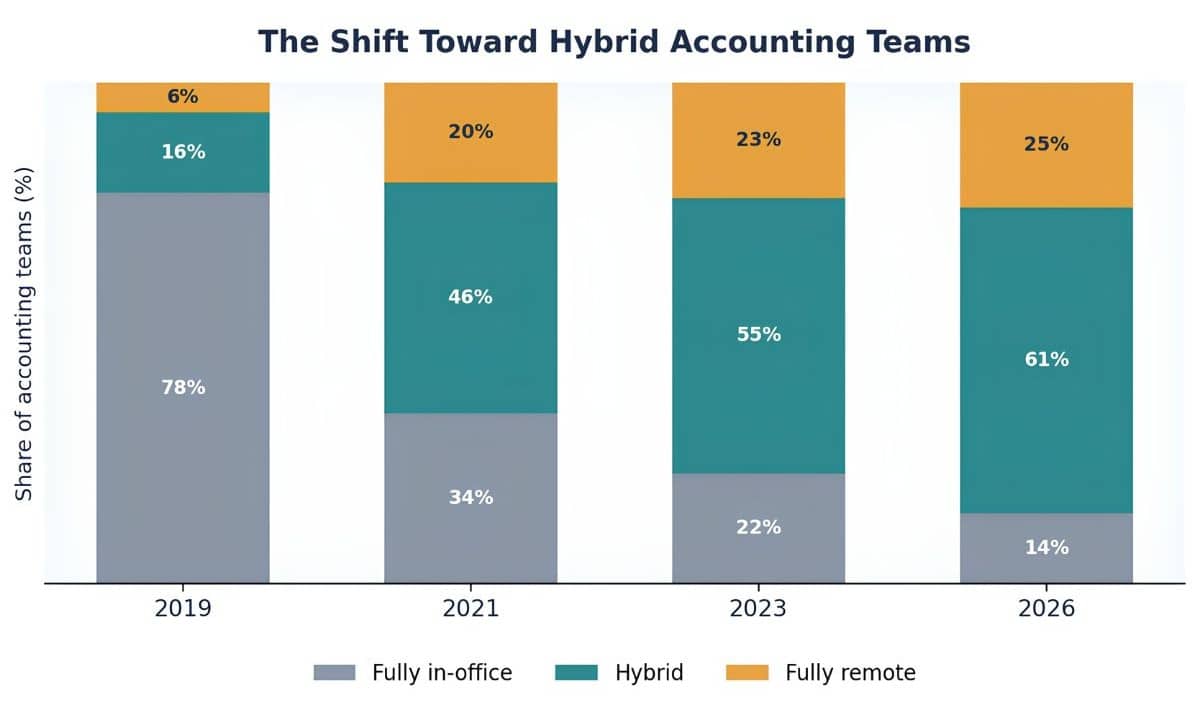
The chart below illustrates the direction of travel we are seeing across the accounting sector: a steady move away from fully in-office arrangements and toward hybrid as the majority working pattern.
What Remote-First Recruitment Actually Means for RPO
This is not simply remote hiring with a few extra video calls bolted onto an otherwise unchanged process. It is a full redesign of how a recruitment process outsourcing partner sources, evaluates, onboards, and retains talent, built from the ground up around people who may never share a physical office with their manager. For RPO providers, adopting Remote-First Recruitment means rebuilding sourcing strategy, screening logic, and onboarding sequencing so that location becomes a secondary filter rather than the starting point.
Practically, that shows up in a handful of concrete changes. Sourcing widens to a national or even cross-border candidate pool instead of a commutable radius. Screening moves toward structured virtual interviews and asynchronous video responses that respect different time zones and working patterns. Onboarding is redesigned so a new hire feels productive and supported from day one, whether their manager is two floors away or two countries away. None of this is exotic technology. It is disciplined process redesign, and it is exactly the kind of redesign that a specialist RPO partner is built to carry out.
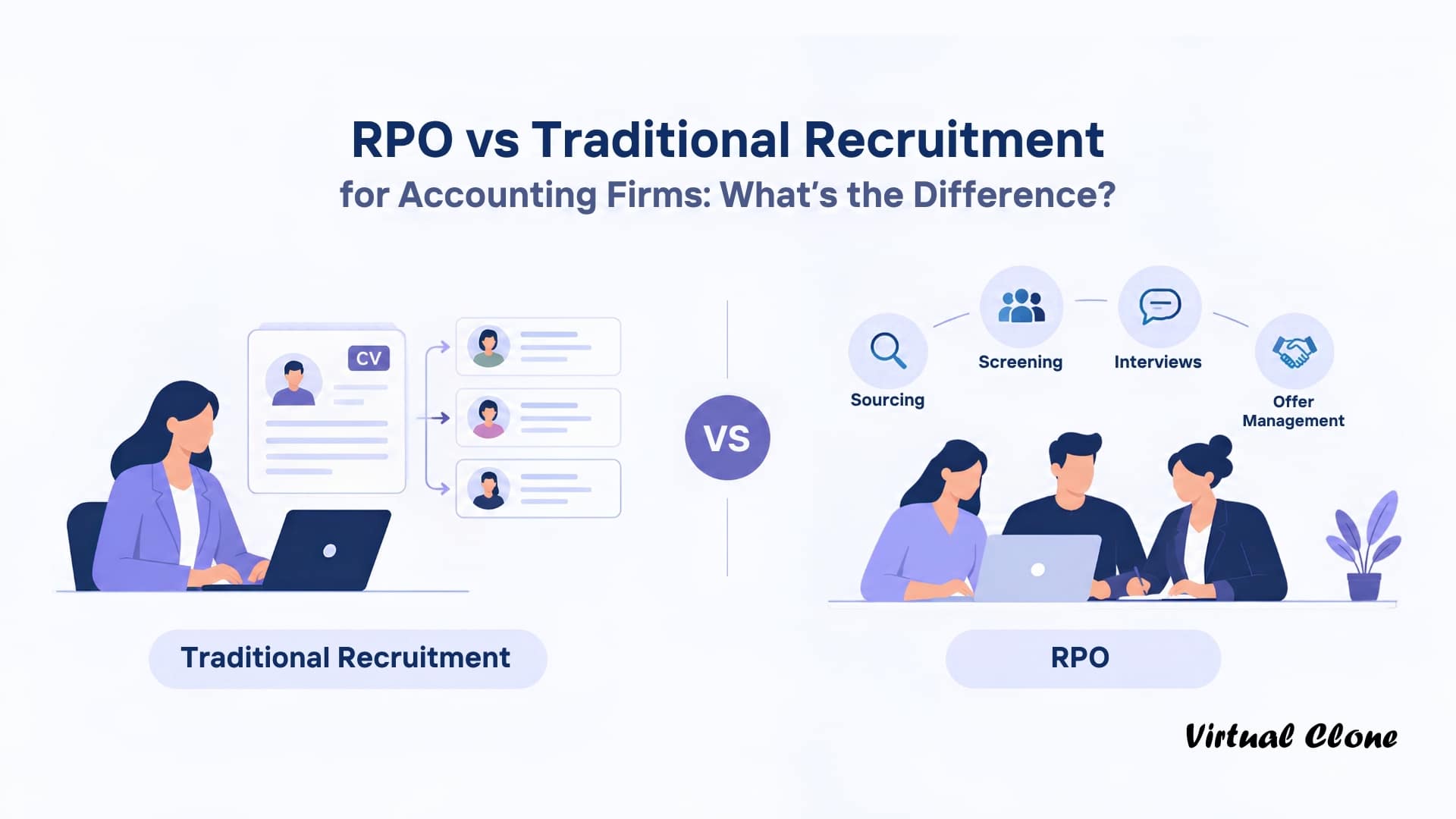
Traditional RPO vs. the Remote-First Hiring Model
The table below sets out how the two models differ across the parts of the hiring lifecycle that firms feel most directly.
| Dimension | Traditional RPO | Remote-First Hiring RPO |
|---|---|---|
| Candidate pool | Bounded by commuting distance to the firm’s office | National and cross-border, sourced against skills rather than postcode |
| Interview process | In-person panel rounds, scheduled around office hours | Structured virtual rounds with async video screening options |
| Onboarding | Desk setup and in-office induction on day one | Pre-shipped equipment, digital induction, buddy system across time zones |
| Technology stack | ATS plus manual scheduling | ATS integrated with video interviewing, e-signature, and collaboration tools |
| Success metric | Time-to-fill | Time-to-productivity and hybrid retention at 12 months |
Four Pillars of a Remote-First Hiring Model
Across the hybrid accounting teams we support, the firms getting the most value from this approach tend to be strong across four connected areas rather than excelling at just one. We think of these as four pillars, and they map closely to the way we structure our own recruitment, accounting, admin, and IT staffing services.
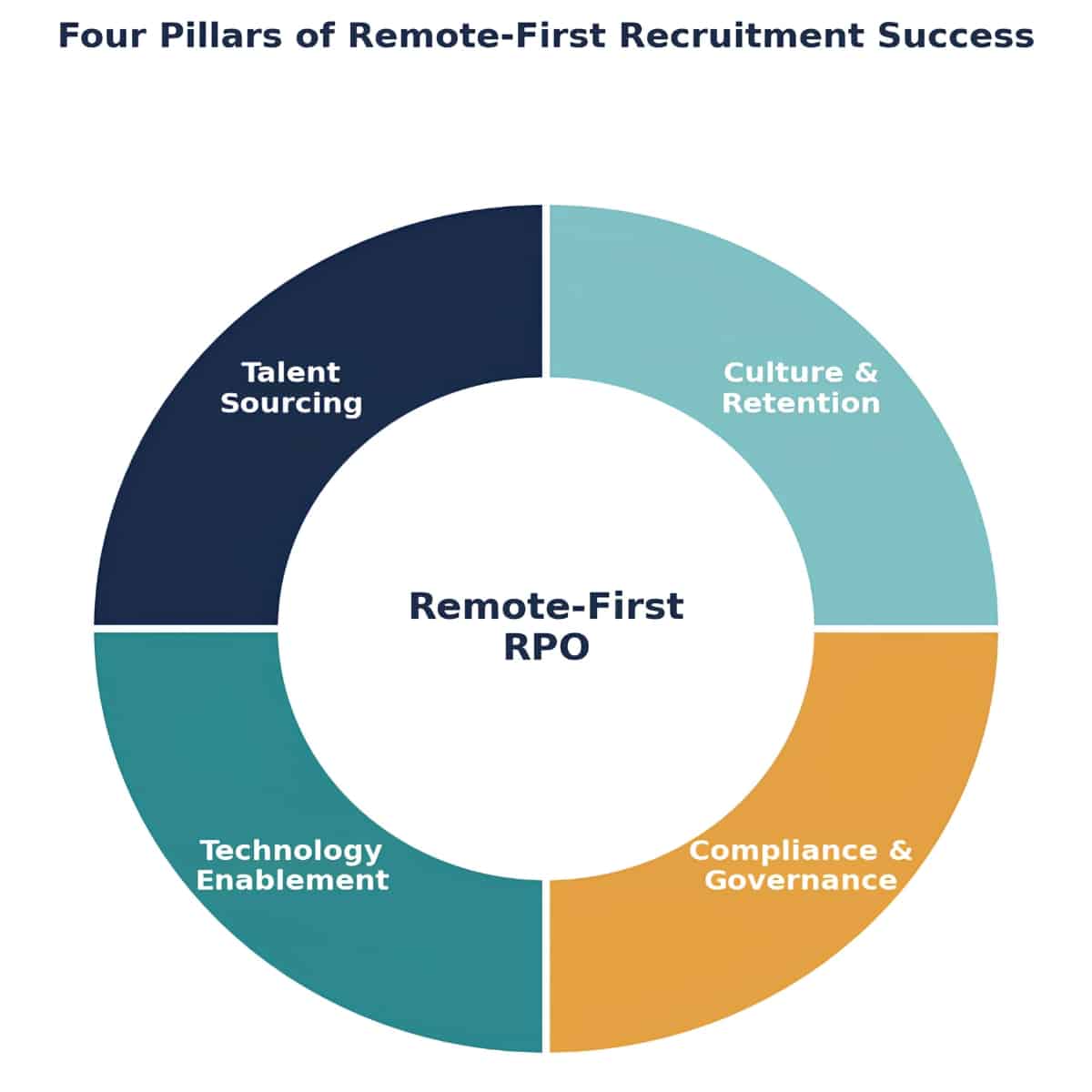
Talent Sourcing
Widening the search beyond a commutable radius only pays off if sourcing is deliberately built to reach candidates wherever they are qualified, rather than wherever they happen to already live near an office.
Technology Enablement
Video interviewing, e-signature, secure document sharing, and cloud accounting platforms need to work together as one connected stack, not a patchwork a candidate has to piece together themselves before their first day.
Compliance and Governance
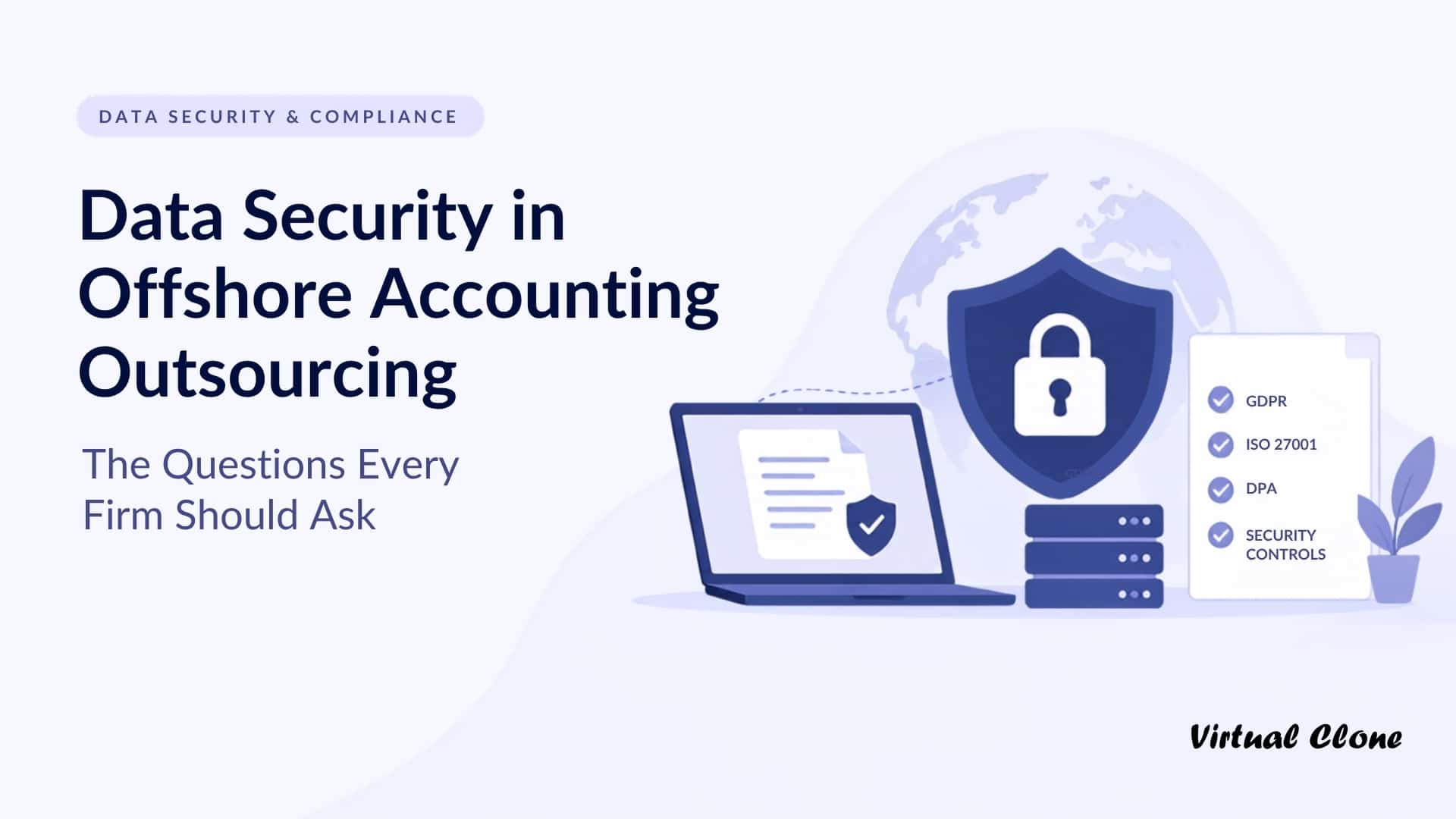
Hybrid does not relax data security or professional standards. If anything, distributed teams need clearer, better-documented controls, which is part of why certifications such as ISO 27001 matter more, not less, in this kind of hiring model.
Culture and Retention
A hire who never sets foot in the office still needs to feel like part of the team. Deliberate onboarding rituals, regular check-ins, and visible career paths do more for hybrid retention than any single piece of software.
How Virtual Clone Supports Remote-First Recruitment for Hybrid Accounting Teams
At Virtual Clone, this approach sits at the centre of how we build accounting and finance teams for firms across the UK, Australia, and the EU. Our recruitment and staffing services are designed for exactly this model, drawing on a wider talent pool while maintaining the governance, compliance, and operational standards that modern accounting firms expect.
Our delivery model is backed by ISO 27001 for information security management and ISO 9001 for quality management, ensuring that every stage of recruitment, onboarding, and day-to-day collaboration follows structured, secure, and documented processes. For firms serving UK and European clients, we also operate with GDPR-aligned data handling practices, ensuring candidate and client information is managed responsibly with confidentiality, secure access controls, and privacy-first processes throughout the recruitment lifecycle.
As an ACCA Approved Employer with delivery teams across India, London, and Sydney, we build hybrid accounting teams that firms trust with client-facing bookkeeping, payroll, tax, management accounting, and year-end accounts—not just back-office support. By combining experienced accounting professionals with secure cloud-based collaboration, structured onboarding, and transparent communication, we help firms scale confidently without compromising quality, compliance, or client service.
The goal is straightforward: firms should be able to hire the best available accounting talent for a role, regardless of which city or country that person happens to live in, while knowing that the recruitment process, onboarding experience, data security, and ongoing governance are as robust as if every team member were working from the same office. This enables accounting firms to embrace remote-first recruitment with confidence, knowing they have a trusted outsourcing partner that prioritises security, compliance, operational excellence, and long-term talent success.
Looking Ahead
The firms winning the talent race over the next few years will be the ones that treat Remote-First Recruitment as infrastructure rather than an experiment. That means investing in sourcing, technology, governance, and culture together, not treating remote hiring as a temporary workaround until things go back to how they used to be. For accounting firms building hybrid teams today, the RPO partner they choose should already be operating this way.
Frequently Asked Questions
What is Remote-First Recruitment in the context of RPO?
It is a recruitment process outsourcing approach that treats remote and hybrid working as the default rather than an exception, redesigning sourcing, screening, onboarding, and retention around candidates who may not share a physical office with their team.
How is RPO different for hybrid accounting teams compared to traditional office-based hiring?
RPO for hybrid accounting teams widens the candidate pool beyond a commutable radius, relies on structured virtual interviewing, and measures success through time-to-productivity and retention rather than time-to-fill alone.
Does this hiring model affect data security and compliance for accounting firms?
It requires more explicit governance, not less. Certifications such as ISO 27001 and ISO 9001, combined with clearly documented onboarding and access controls, are what let firms extend hiring beyond the office without compromising client data security.
How does Remote-First Recruitment help accounting firms overcome talent shortages?
Remote-First Recruitment removes geographical hiring limitations, allowing accounting firms to access qualified professionals from a much wider talent pool. This reduces hiring delays, improves access to specialist skills, and helps firms maintain service quality during peak accounting periods.
What are the benefits of partnering with an RPO provider for hybrid hiring?
An RPO partner streamlines the entire recruitment lifecycle—from sourcing and screening candidates to onboarding and retention. This helps accounting firms reduce time-to-hire, improve hiring quality, lower recruitment costs, and build scalable hybrid teams without increasing internal recruitment workloads.
Can remote accounting professionals work securely with sensitive client data?
Yes. When supported by secure technology and robust governance, remote accounting teams can safely handle confidential financial information. Businesses should look for outsourcing partners that follow ISO 27001, GDPR-aligned data protection practices, secure cloud infrastructure, role-based access controls, and documented security procedures.
Which accounting roles are best suited for Remote-First Recruitment?
Remote-first hiring works particularly well for bookkeeping, accounts payable and receivable, payroll processing, VAT compliance, tax preparation, management accounting, audit support, financial reporting, and year-end accounts. Many firms also recruit remote administrative and IT support roles using the same approach.
How does Remote-First Recruitment improve employee retention?
Flexible working arrangements, structured onboarding, continuous communication, career development opportunities, and collaborative digital workplaces contribute to higher employee satisfaction. These factors help accounting firms retain skilled professionals and reduce recruitment costs over the long term.
What technology is essential for managing hybrid accounting teams?
Successful hybrid accounting teams rely on cloud accounting platforms, applicant tracking systems (ATS), secure document management, video conferencing, collaboration tools, e-signature solutions, and cybersecurity measures that enable seamless communication while protecting sensitive financial data.
Is Remote-First Recruitment suitable for small and mid-sized accounting firms?
Absolutely. Small and medium-sized accounting firms often benefit the most because Remote-First Recruitment enables them to compete for skilled talent beyond their local market without significantly increasing recruitment overheads. It also provides greater flexibility to scale teams as client demand grows.
How does Virtual Clone support hybrid accounting teams?
Virtual Clone provides recruitment, accounting and bookkeeping, admin, and IT staffing support from offices in India, London, and Sydney, built around this hiring approach and backed by ISO 27001, ISO 9001, and ACCA Approved Employer status.