

Every conversation we have with a prospective client reaches the same moment. The numbers work, the capacity problem is real, the timing suits the firm, and then someone in the room says it out loud: what happens to our clients' data?
It is the right question. Accounting practices hold some of the most sensitive information anyone owns, from payroll records and bank feeds to personal tax returns and the private finances of owner-managed businesses. Handing any of that to a team you have never met, in a country you may never visit, deserves proper scrutiny rather than a reassuring brochure.
So let us answer it properly. When we talk about data security in offshore accounting outsourcing, we are not talking about trust or good intentions. We are talking about a documented chain of controls that you can inspect, test and evidence to your professional body, your insurer and your clients. This article walks through what that chain looks like, where the genuine risks sit, and the exact questions we think you should put to any provider before you send them a single file.
What Does Data Security in Offshore Accounting Outsourcing Actually Mean?
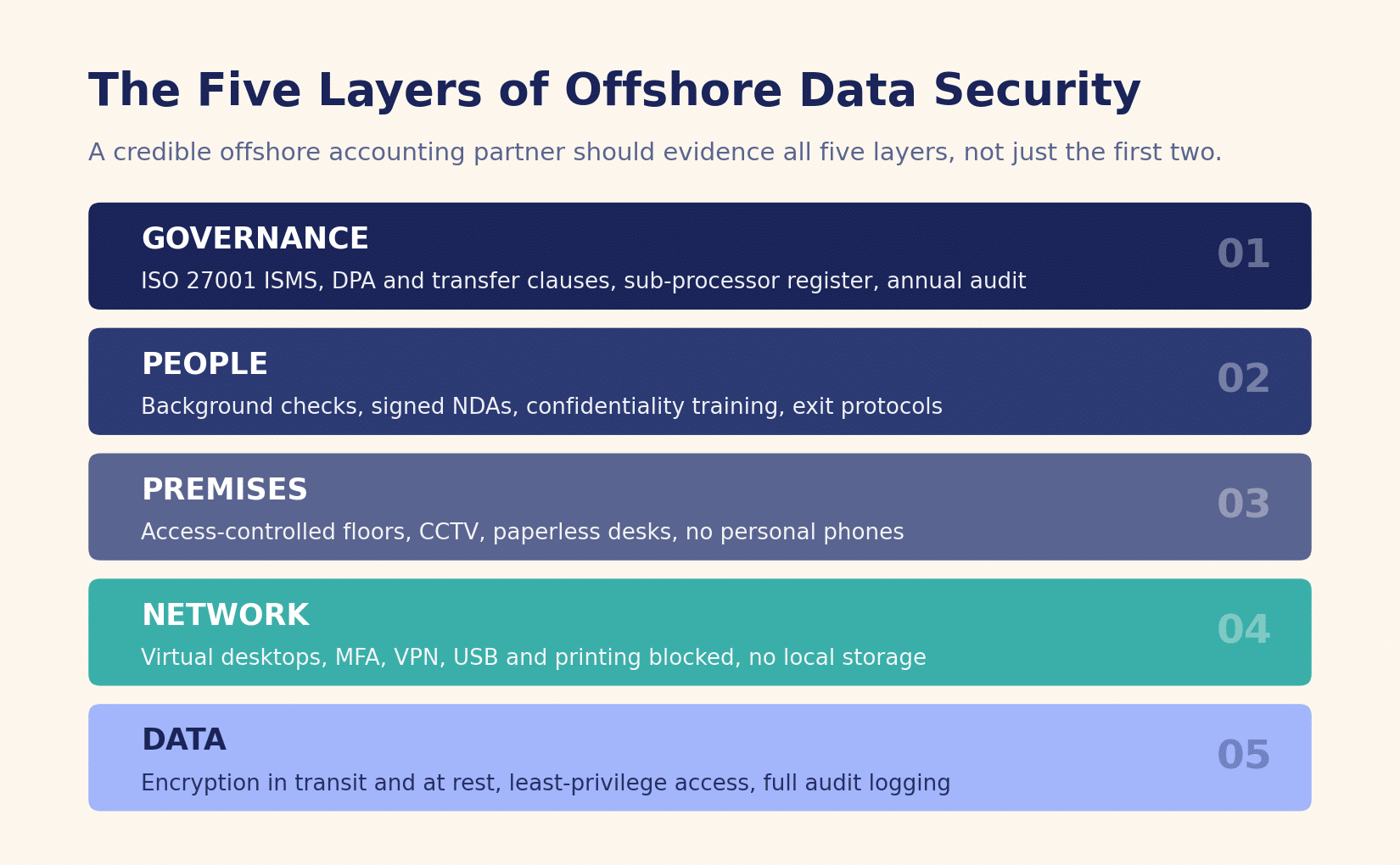
It means five layers working together, and a provider who can show you evidence at every one of them. Governance sets the rules and proves they are followed. People controls decide who may ever touch your data. Premises controls decide what can physically leave the building. Network controls decide where data can travel. Data controls decide what the information looks like if anything does slip through.
Most providers talk fluently about the first two layers because they are the easiest to describe. The layers that actually stop incidents are the middle three, and those are the ones worth probing in detail.
Does Offshoring Your Accounting Work Break GDPR?
No, and this is the single most common misconception we meet. Neither UK GDPR nor EU GDPR prohibits processing data outside the country. Both set conditions for doing it lawfully. Once those conditions are met, the arrangement is entirely legitimate, which is why thousands of regulated firms across Britain, Ireland, Germany and Australia already run offshore delivery teams.
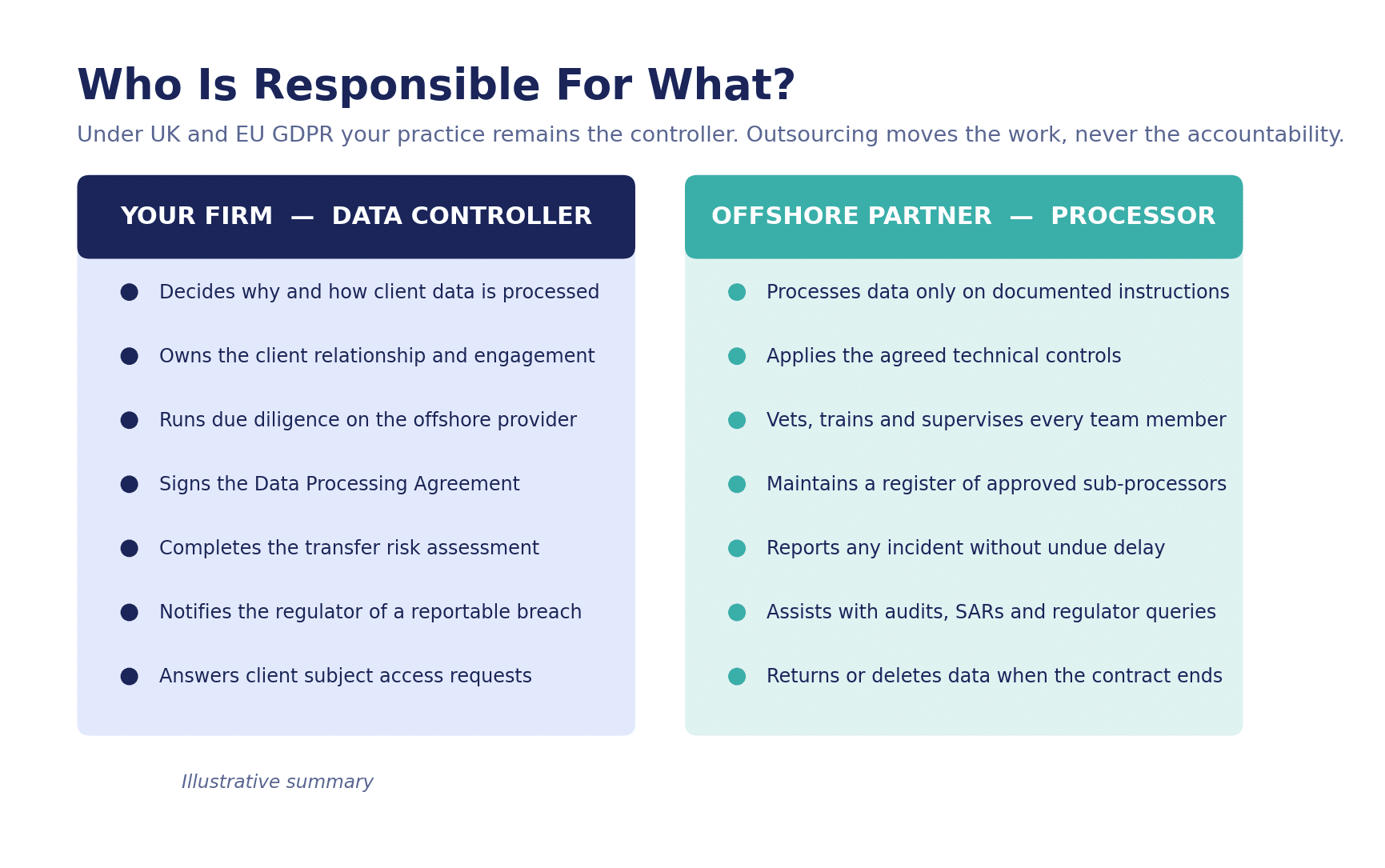
The legal backbone here is the controller and processor relationship. Your practice remains the controller because you decide why and how client data is processed. We act as the processor, working only on your documented instructions. That distinction matters enormously, because it means outsourcing moves the work but never the accountability. If something goes wrong, the regulator will still be talking to you, which is precisely why your due diligence has to be real.
The regulations that apply to your transfer
Which instruments you need depends on where your clients sit rather than where the work is done. The table below maps the common positions we see across our UK, Australian and EU client base.
| Regime | Applies when | What you need in place |
|---|---|---|
| UK GDPR & DPA 2018 | Your firm or your clients are in the United Kingdom | Written processor contract under Article 28, the UK International Data Transfer Agreement or the Addendum to EU clauses, plus a transfer risk assessment |
| EU GDPR | Your firm or your clients are in an EU or EEA member state | Article 28 processor contract, Standard Contractual Clauses, and a transfer impact assessment documenting supplementary measures |
| Australian Privacy Act 1988 | Your firm or your clients are in Australia | Australian Privacy Principle 8 compliance, reasonable steps to ensure the overseas recipient does not breach the APPs, and eligible data breach reporting readiness |
| India DPDP Act 2023 | Data is processed by a provider based in India | Provider-side obligations on security safeguards, breach notification and purpose limitation, which strengthen your position as controller |
| Professional body rules | You are regulated by ICAEW, ACCA, CPA Australia or similar | Client confidentiality obligations, disclosure of subcontracting in your engagement letters, and appropriate professional indemnity cover |
Table 1: An illustrative mapping of the instruments most often required. Confirm the current position with your own legal adviser and regulator before relying on it.
Where The Real Risks Sit, And It Is Rarely The Country
When we review incidents reported across professional services, the pattern is remarkably consistent. Data is lost through email sent to the wrong recipient, through unencrypted files on personal devices, through weak or reused passwords, through leavers whose access was never revoked, and through convincing invoice fraud. Geography almost never appears in that list.
This matters because the security debate tends to focus on the wrong variable. A firm can spend months worrying about a delivery centre in Nagpur while a local freelance bookkeeper downloads client records to a home laptop with no encryption, no logging and no contract. One of those arrangements is auditable and one is not.
| The worry | What we actually see | How a good provider answers it |
|---|---|---|
| “Our data will be copied and taken home” | Local download is the highest practical risk in any arrangement, onshore or offshore | Virtual desktop only, with USB ports, printing, personal email and cloud uploads all blocked at policy level |
| “We will lose visibility of who is doing the work” | Visibility is contractual, not geographical. Unnamed staff are the real problem | Named, badged team members assigned to your firm, with access logs you can request |
| “Overseas staff are not bound by our rules” | They are bound by whatever your contract and their employer requires | Signed NDAs, background verification, annual confidentiality training and disciplinary escalation |
| “We cannot audit a site on another continent” | Most firms never audit their onshore suppliers either | Remote audit rights, current ISO 27001 certificate, policy pack and an open invitation to visit |
| “A breach would be impossible to manage” | Slow escalation, not distance, is what turns an incident into a penalty | Named incident contact, contractual reporting window, and a documented response plan |
Table 2: Common concerns set against what a well-run offshore operating model should be able to demonstrate.
Seven Questions To Ask Before You Sign Anything
Here is the part we would encourage you to copy into your own procurement notes. Almost all of data security in offshore accounting outsourcing comes down to evidence you can file, so ask every provider on your shortlist the same seven questions and compare the answers side by side. Vague replies are themselves an answer.
| S.N. | The question | What a strong answer looks like | Walk away if |
|---|---|---|---|
| 1 | Are you ISO 27001 certified, and may we see the certificate and scope? | A current certificate from an accredited body, with the delivery centres you will actually use named in the scope | They cite “ISO standards” without a certificate, or the scope excludes your delivery site |
| 2 | Will you sign our Data Processing Agreement with transfer clauses? | Yes, with sensible negotiation on detail and no resistance to audit or deletion rights | They insist only their own terms apply, or cannot explain the transfer mechanism |
| 3 | How do staff access our systems? | Virtual desktop or remote gateway with multi-factor authentication, no data at rest on local machines | Files are emailed, shared over consumer cloud drives, or downloaded to local desktops |
| 4 | What physical controls apply on the delivery floor? | Access-controlled entry, CCTV, paperless desks, no personal phones and a clean-desk policy | Open-plan shared space, or team members permitted to work from home with no controls |
| 5 | How are team members vetted and trained? | Documented background verification, signed NDAs, induction and annual refresher training with records | Verbal assurances only, or no record of who has been trained and when |
| 6 | What happens in the first 24 hours of an incident? | A named contact, a written escalation path, and a contractual reporting window inside your 72-hour duty | “We would let you know”, with no plan, no owner and no timescale |
| 7 | What happens to our data when we leave? | Certified deletion or secure return within a defined window, with written confirmation | No exit clause, or an answer that depends on goodwill |
Table 3: A shortlist comparison tool. Score each provider out of seven and keep the evidence on file.
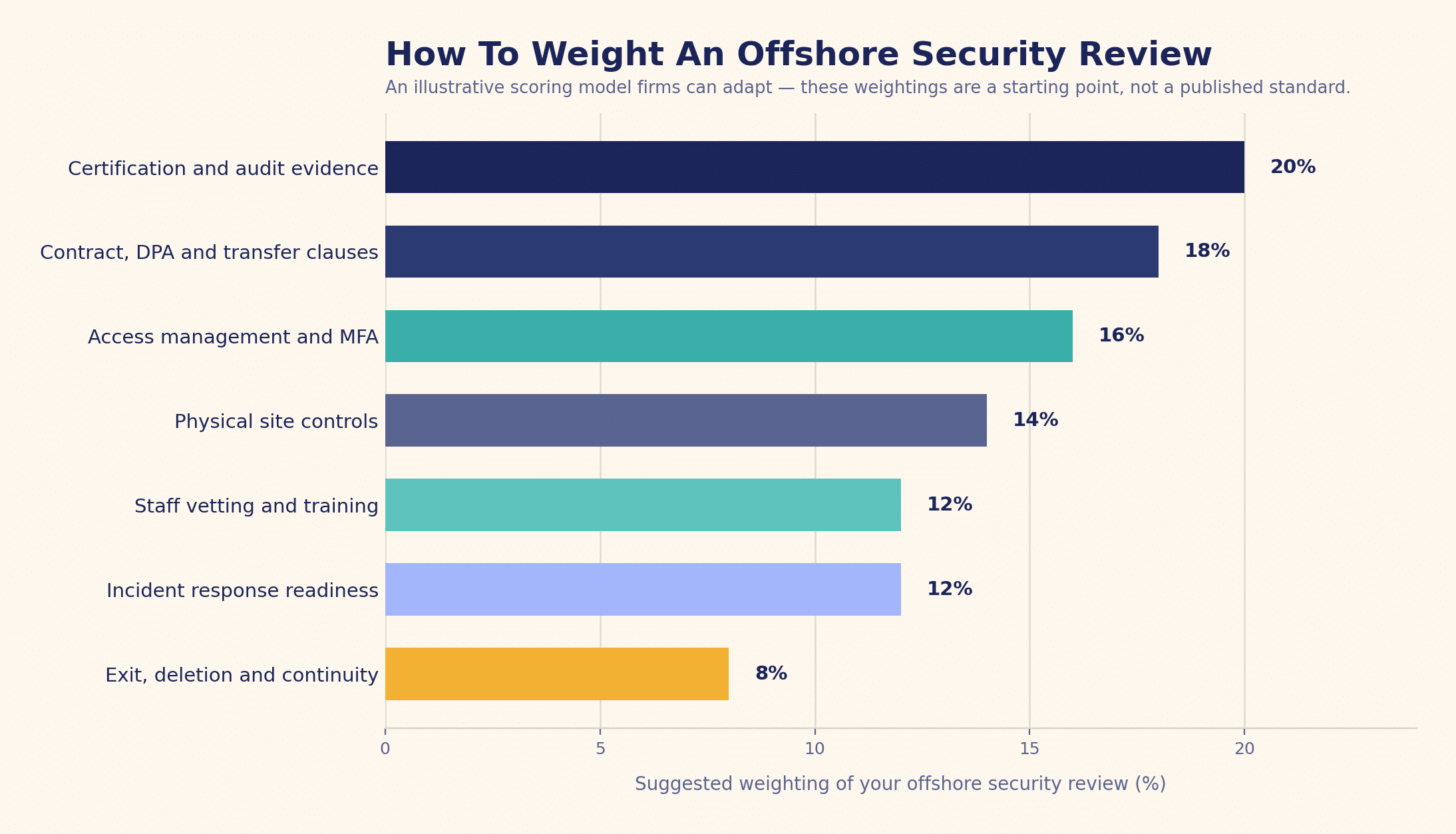
If you want to weight the review rather than simply tick it, the model below is a reasonable starting point. Certification and contract carry the most weight because they are the only elements you can rely on when the relationship is under strain.
What Happens When Something Actually Goes Wrong?
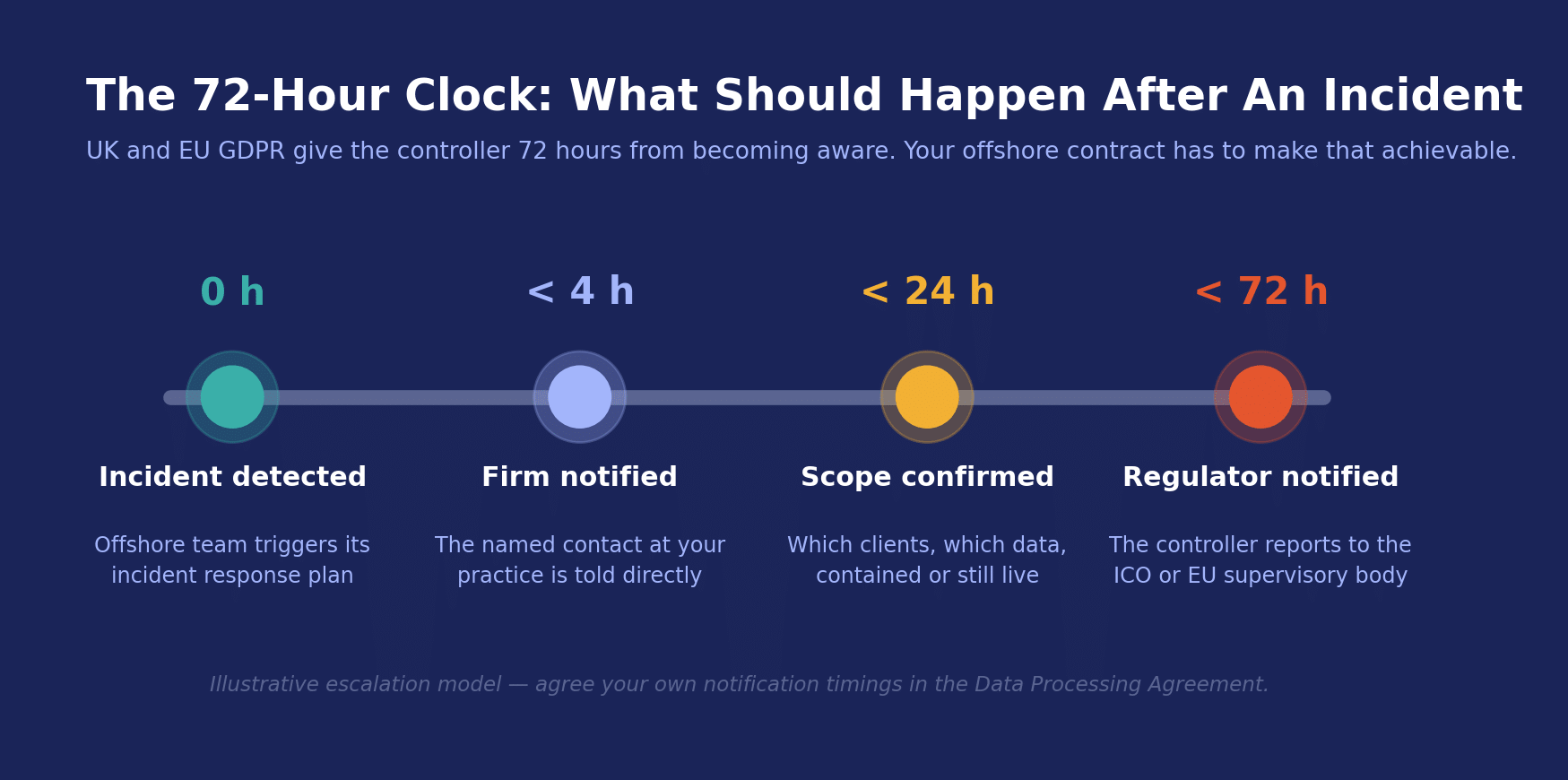
Assume, for a moment, that it will. Mature security planning starts from the assumption of failure rather than the promise of perfection. Under UK and EU GDPR you have 72 hours from becoming aware of a reportable personal data breach to notify the supervisory authority. Australian firms face a similar obligation under the Notifiable Data Breaches scheme.
The uncomfortable arithmetic is that your clock starts when your provider tells you. If their contract allows them a week to report, you have already failed before you knew anything was wrong. This is why we push clients to negotiate the notification window explicitly rather than accept a vague commitment to act without undue delay.
How We Approach Data Security At Virtual Clone
We are an offshore accounting outsourcing firm serving practices across the UK, Australia and the EU from delivery centres in Nagpur and Mumbai, and we treat data security in offshore accounting outsourcing as an operating discipline rather than a sales message. The short version is that we hold ISO 27001 for information security, ISO 9001 for quality management, and ACCA Approved Employer status, and we expect clients to verify all three rather than take our word for it.
| Control area | What this means in practice at Virtual Clone |
|---|---|
| Certification | ISO 27001 information security management system and ISO 9001 quality management, with ACCA Approved Employer recognition for how we train and develop our accountants |
| Contracting | We sign your Data Processing Agreement, accept international transfer clauses, and maintain confidentiality undertakings from every individual on your engagement |
| Access | Work is performed on your systems or on controlled virtual desktops with multi-factor authentication, least-privilege permissions and full activity logging |
| Premises | Access-controlled delivery floors with CCTV, paperless desks, restricted personal devices and a clean-desk policy enforced daily |
| People | Background verification before joining, signed non-disclosure agreements, induction and annual confidentiality training, with immediate access revocation on exit |
| Continuity | Documented incident response with a named escalation contact for your firm, plus backup and recovery arrangements across our two delivery centres |
A Practical 30-Day Due Diligence Plan
Firms often tell us they know what to check but not how to sequence it. This is the timetable we suggest, and it fits comfortably alongside a normal workload.
| Week | What you do | What you should hold at the end of it |
|---|---|---|
| Week 1 | Define the data you intend to share, the systems involved and the client consent position in your engagement letters | A written scope of processing and a short data flow description |
| Week 2 | Issue the seven questions to each shortlisted provider and request certificates, policies and a sample contract | A comparison sheet with evidence attached, not assurances |
| Week 3 | Run a live walkthrough of the working environment and test the access controls yourself | Screenshots or notes confirming the controls behave as described |
| Week 4 | Finalise the Data Processing Agreement, transfer clauses, notification window and exit terms with your adviser | A signed agreement and a completed transfer risk assessment on file |
Table 5: A four-week due diligence sequence. Adapt the pace to the sensitivity of the data involved.
Frequently Asked Questions
Is offshore accounting outsourcing GDPR compliant?
Yes, provided the transfer is structured correctly. UK and EU GDPR permit processing outside the country where a valid transfer mechanism is in place, such as the UK International Data Transfer Agreement or EU Standard Contractual Clauses, supported by an Article 28 processor contract and a transfer risk assessment. Your firm remains the controller and retains accountability throughout.
Is data security in offshore accounting outsourcing weaker than keeping the work in-house?
Not inherently. Security depends on the controls applied rather than the location of the desk. An ISO 27001 certified provider running locked-down virtual desktops with vetted staff and full audit logging is frequently more controlled than an in-house arrangement where files move by email and access is never reviewed. The honest comparison is control against control, not offshore against onshore.
Do we have to tell our clients that work is being outsourced?
In most cases yes, and it is good practice regardless. Professional bodies including ICAEW and ACCA expect confidentiality obligations to be addressed, and your privacy notice and engagement letters should disclose that processing may be carried out by a subcontractor. We would encourage you to confirm the exact wording with your regulator or professional adviser.
What does ISO 27001 certification actually prove?
It proves that an independent accredited body has audited the provider's information security management system against the standard and found it conforming. It is evidence of a managed, reviewed and documented approach rather than an absolute guarantee. Always check the certificate is current and that its scope covers the delivery centre doing your work.
Can our data be downloaded or removed by offshore staff?
It should not be technically possible. In a properly configured environment the team works inside a virtual desktop or directly in your cloud software, with local downloads, USB devices, printing and personal email blocked. Ask to see the policy that enforces this, and then ask to test it yourself during a walkthrough.
How quickly must a provider report a security incident to us?
Faster than your own regulatory deadline allows, which in the UK and EU is 72 hours from becoming aware. We suggest agreeing a contractual window of a few hours to the named contact at your firm, so that you retain enough time to assess, contain and notify rather than inheriting a problem with the clock already run down.
The Bottom Line
Data security in offshore accounting outsourcing is not a leap of faith. It is a set of checks you can run, evidence you can file and controls you can test, and any provider worth engaging will welcome the scrutiny rather than deflect it.
If a provider cannot show you a current certificate, will not sign your agreement, cannot explain how access is controlled or has no answer for the first 24 hours after an incident, you have learned everything you need to know. If they can, you are in a stronger position than most firms manage with the arrangements they already have in place at home.