

OFFSHORE TALENT · HIRING GUIDE
OFFSHORE TALENT · HIRING GUIDE
A practical guide for accounting firms in the UK, Australia and Europe that want to hire offshore accountants with the right market knowledge, software skills and data safeguards from day one.
Every accounting firm we speak to has the same question about offshore hiring, whether it's a ten-person practice in Leeds, a growing firm in Melbourne or a cross-border VAT specialist in Amsterdam. It isn't really about cost. It's about competence: will someone thousands of kilometres away genuinely understand how our clients' tax system works?
It's a fair question, and the honest answer is that it depends on who you hire and how. India has one of the largest pools of qualified accountants in the world, and many of them have spent years working exclusively on UK, Australian or European client files. Others are excellent accountants who have never filed a VAT return or lodged a BAS. On a CV, the two can look almost identical.
This guide shows you how to tell them apart. We'll walk through what market-ready skills look like in each region, the engagement models on offer, how to interview and test candidates, and the safeguards that keep your clients' data protected. If you plan to hire offshore accountants in the next twelve months, it should save you a few expensive lessons.
Can offshore accountants in India really handle UK, Australian and EU compliance?
Yes, and a great many already do. Indian accounting teams have supported UK practices for more than two decades, and the same delivery model now serves firms across Australia and Europe. The foundations of good accounting, such as double-entry bookkeeping, reconciliation discipline and an eye for anomalies, are universal. What changes between markets is the layer on top: the tax rules, filing deadlines, payroll systems, software and even the vocabulary.
That layer can be learned, but it isn't automatic. An accountant who qualified in India and has only worked on Indian GST will need structured training before they're productive on a UK client's VAT return. One who has spent three years preparing BAS statements for Australian practices can contribute from the first week. So the real question isn't whether offshore accountants can do the work. It's whether the particular people you hire have been trained, tested and supervised on your market.
What market-ready looks like in the UK, Australia and Europe
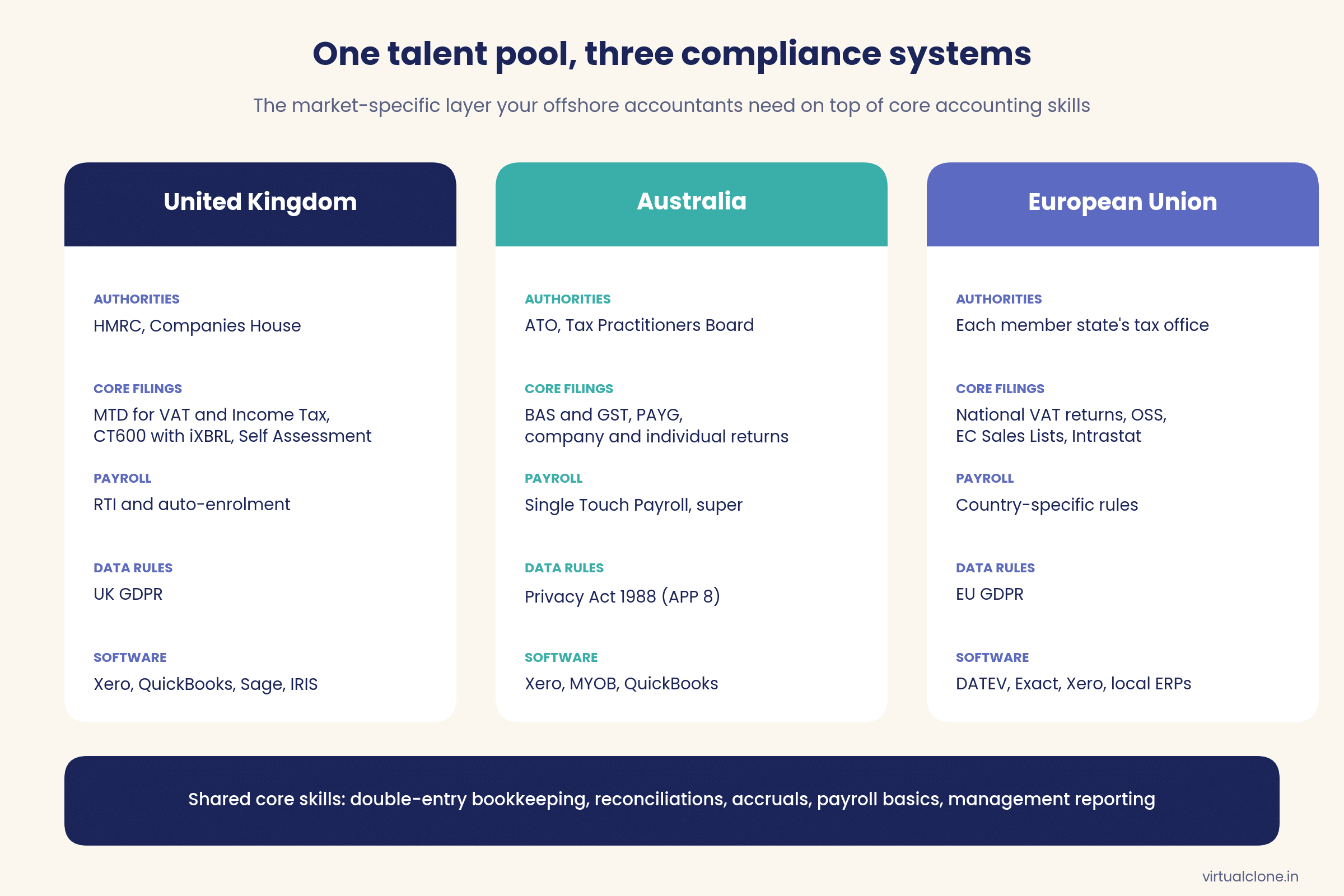
Before you look at a single CV, it helps to be precise about the market knowledge the role needs. The table below summarises the compliance work, software and experience to look for in each region, followed by the details that most often catch firms out.
Market |
Core compliance work |
Software to test on |
Experience to look for |
|---|---|---|---|
| United Kingdom | MTD for VAT and Income Tax, year-end accounts under FRS 102 and 105, CT600 with iXBRL, Self Assessment, RTI payroll | Xero, QuickBooks Online, Sage, IRIS or CCH | UK client files; ACCA with UK-variant tax and law papers |
| Australia | BAS and GST, PAYG withholding and instalments, company and individual returns, Single Touch Payroll, superannuation | Xero, MYOB, QuickBooks Online | Australian client files; work prepared for a registered tax agent |
| European Union | National VAT returns, OSS for cross-border sales, EC Sales Lists and Intrastat, local statutory accounts | DATEV, Exact, Xero, local ERPs | The member states you serve; comfort with documents in local languages |
For UK firms
UK work rewards candidates who keep up with change. Making Tax Digital for VAT has applied to all VAT-registered businesses since April 2022, and MTD for Income Tax has applied to sole traders and landlords with qualifying income above £50,000 since April 2026, with the threshold falling to £30,000 in April 2027. Add RTI payroll, auto-enrolment pensions and year-end accounts with iXBRL-tagged CT600s, and it's clear why general accounting knowledge isn't enough. ACCA is a useful signal here: it's widely studied in India and offers UK-variant papers in taxation and law.
For Australian firms
Australian compliance runs to a different rhythm. Most small businesses lodge BAS quarterly, payroll is reported through Single Touch Payroll, and the superannuation guarantee rate has been 12% since 1 July 2025. Offshore accountants can prepare this work, but lodgement and professional responsibility sit with your registered tax agent, so look for people who are used to preparing work for review by an Australian agent and who know Xero and MYOB well. The Tax Practitioners Board's guidance on client confidentiality is worth reading before you share client information offshore.
For European firms
Europe is the most demanding of the three, because there's no single system to learn. VAT rates, return formats and deadlines differ by member state, cross-border e-commerce sellers use the One-Stop Shop, and mandatory e-invoicing is spreading country by country, with Belgium, Poland and France all introducing requirements in 2026 ahead of EU-wide rules for cross-border B2B invoices from 2030. Narrow the role to the countries you actually serve, test on the software your clients use (DATEV in Germany and Exact in the Netherlands are common), and ask how the team handles invoices in languages they don't read. A good answer involves a defined process, never guesswork.
Which engagement model is right for your firm?
Once you know the skills you need, the next decision is how you'll engage people. There are four common routes, and each trades control, continuity and management effort in a different way. Firms that hire offshore accountants for recurring work usually find that continuity matters most, because every month the same person spends on your clients makes them faster and more accurate.
Model |
Who does the work |
Continuity |
Data security |
Your management effort | Best for |
|---|---|---|---|---|---|
| Freelancer or marketplace hire | An individual contractor you find and vet yourself | Low: people move on | Hard to verify; often personal devices | High: you vet, train and supervise | One-off overflow tasks |
| Task-based outsourcing | Whoever in the provider’s pool is free | Medium: work can rotate | Set by the provider | Low to medium | Defined, standalone jobs |
| Dedicated offshore team | Named professionals working only on your clients | High: the same people every month | Strong with an ISO 27001 employer | Medium: you direct, the employer runs HR and IT | Recurring work that needs your methods and client knowledge |
| Your own offshore entity | Your own employees in India | High | Entirely your responsibility | Very high: entity, payroll, premises | Large firms ready to run an overseas office |
For most small and mid-sized firms, the dedicated model offers the best balance. You get named professionals who learn your clients and your methods, while the employer handles recruitment, HR, IT, security and cover for leave. Setting up your own entity in India gives you full control, but it also makes you responsible for local employment law, payroll, premises and data security, which tends to make sense only at significant scale. If you're weighing a recruitment-led approach against traditional hiring, our guide to RPO versus traditional recruitment for accounting firms covers that decision in more depth.
Time zones: why India works for all three markets
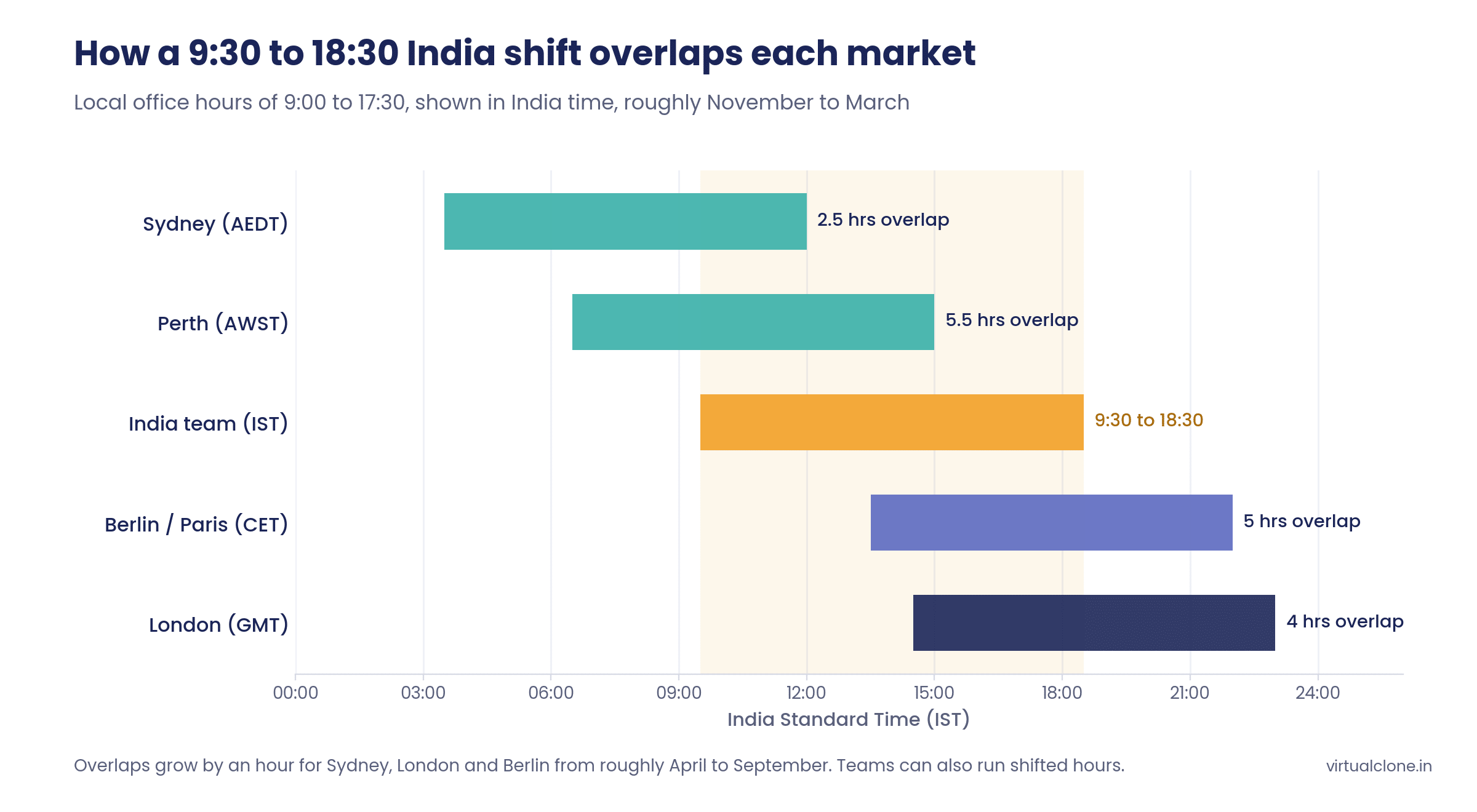
India's position is a genuine advantage for firms in all three regions. It sits between Australia and Europe, so a standard Indian working day catches the Australian afternoon in its morning and the European and UK working day in its afternoon.
Office |
Local office hours |
In India time (Nov–Mar) |
Overlap (Nov–Mar) |
Overlap (Apr–Sep) |
|---|---|---|---|---|
| Sydney | 9:00–17:30 AEDT / AEST | 03:30–12:00 | 2.5 hours | 3.5 hours |
| Perth | 9:00–17:30 AWST | 06:30–15:00 | 5.5 hours | 5.5 hours |
| Berlin / Paris | 9:00–17:30 CET / CEST | 13:30–22:00 | 5 hours | 6 hours |
| London | 9:00–17:30 GMT / BST | 14:30–23:00 | 4 hours | 5 hours |
Based on a 9:30 to 18:30 India shift. Daylight-saving changes happen on different dates in each region, so overlaps shift by an hour for a few weeks each spring and autumn.
In practice, that overlap is plenty for daily check-ins, queries and reviews, and the hours on either side become productive quiet time for processing. Where a firm needs more live collaboration, teams can work shifted hours, such as a later shift aligned to UK afternoons or an earlier start for Sydney.
How to hire offshore accountants in six steps
Here's the process we recommend to firms that hire offshore accountants for the first time. It works whether you're filling one role or building a team of ten.
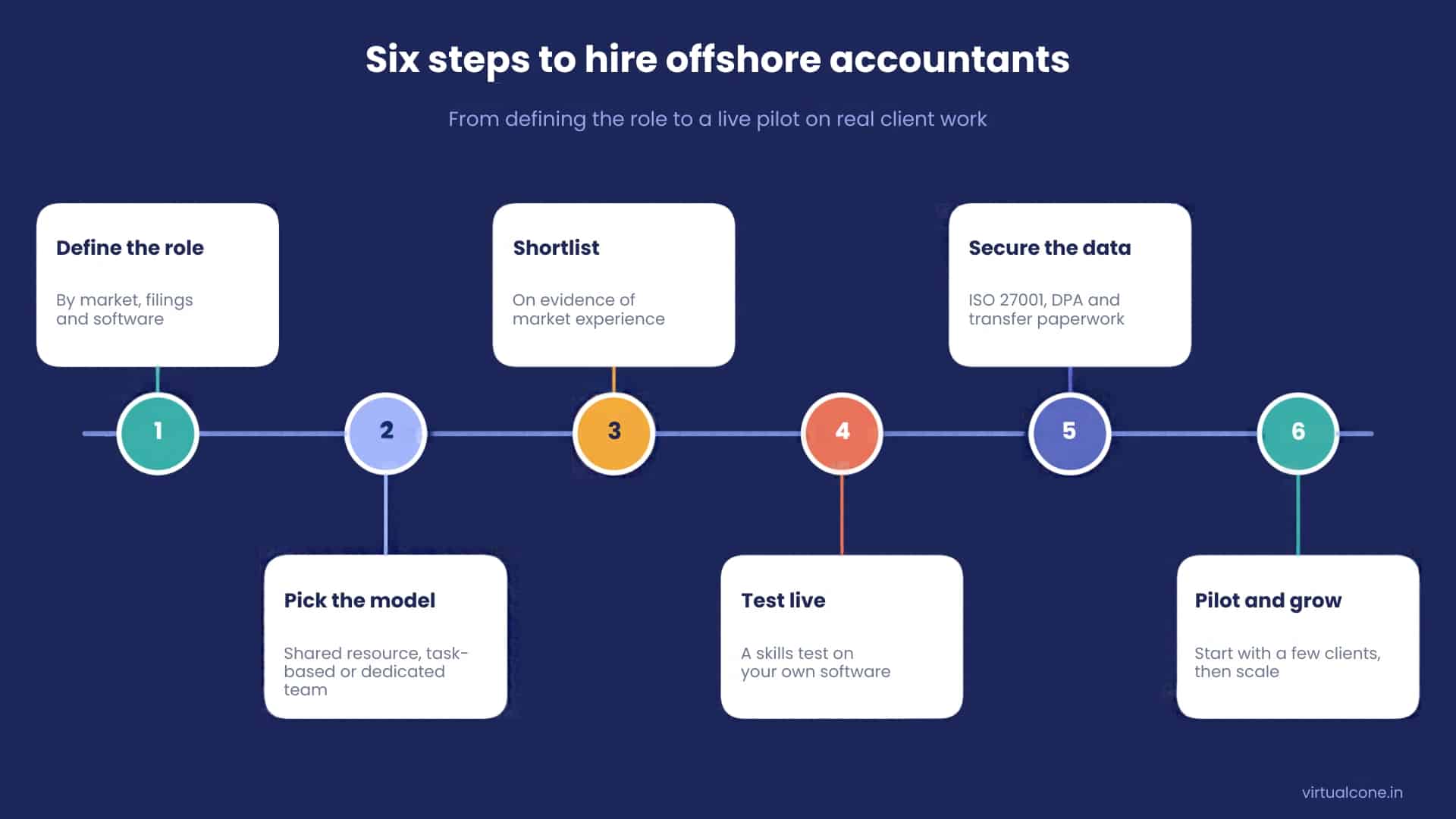
1. Define the role by market, not just job title
“Accountant” means very different things in Manchester, Brisbane and Rotterdam. Write a role profile that names the market, the filings, the software and the volume of work, for example “quarterly BAS and monthly bookkeeping for 25 Xero clients”. That single sentence will filter candidates more effectively than any qualification requirement.
2. Choose your engagement model
Decide early whether you need occasional overflow help, defined tasks or a dedicated team, using the comparison above. The model shapes everything that follows, from who you interview to how data access is set up.
3. Shortlist on evidence of market experience
Ask for specifics rather than claims. How many UK VAT returns has the candidate prepared? Which Australian payroll set-ups have they handled? Which EU countries have they filed for? Concrete numbers and examples are the clearest sign of real experience.
4. Interview with a live skills test on your software
Nothing replaces watching someone work. Give shortlisted candidates a short, realistic task in your own software, such as reconciling a bank feed with a few deliberate errors or coding a batch of purchase invoices for VAT or GST. The questions below make a useful companion to the practical test.
Six questions to ask in every interview
| Ask this | What a typical strong answer looks like | |
|---|---|---|
| “Walk me through a UK VAT return you prepared last quarter.” | MTD-compatible software, reconciling the VAT control account, and checks for reverse charge or partial exemption where relevant | |
| “How do you prepare a quarterly BAS for a GST-registered client?” | Reviewing GST coding, reconciling to the ledger, PAYG withholding, and preparing it for the registered agent to lodge | |
| “What changed for UK sole traders and landlords in April 2026?” | MTD for Income Tax: digital records and quarterly updates for qualifying income over £50,000 | |
| “How do you handle an invoice in a language you don’t read?” | A defined process using translation tools, a glossary and escalation, never guessing a VAT code | |
| “Your bank feed doesn’t match the ledger at month-end. What do you do?” | Investigate before adjusting, document the difference and raise a query rather than forcing a balance | |
| “Which of our software platforms have you used, and for how long?” |
|
5. Put security and data transfer safeguards in place
Your firm remains responsible for client data wherever it’s processed. India doesn’t have a UK or EU adequacy decision, so for UK and EU clients you’ll need a data processing agreement plus an approved transfer mechanism: typically the ICO’s International Data Transfer Agreement or the UK Addendum for UK data, and the EU standard contractual clauses with a transfer impact assessment for EU data. For Australian clients, Australian Privacy Principle 8 requires you to take reasonable steps to ensure an overseas recipient handles personal information properly, and your firm can remain accountable if it doesn’t. An employer certified to ISO 27001 has had its security controls independently audited, which makes all of this considerably easier to evidence.
6. Onboard with a pilot and a named point of contact
Start with a small group of clients, ideally those on cloud software with tidy records, and agree a review process and a weekly check-in from day one. Name one person in your firm who briefs the team and answers questions. Once quality and turnaround are consistent, often within the first two or three months, you can widen the scope with confidence.
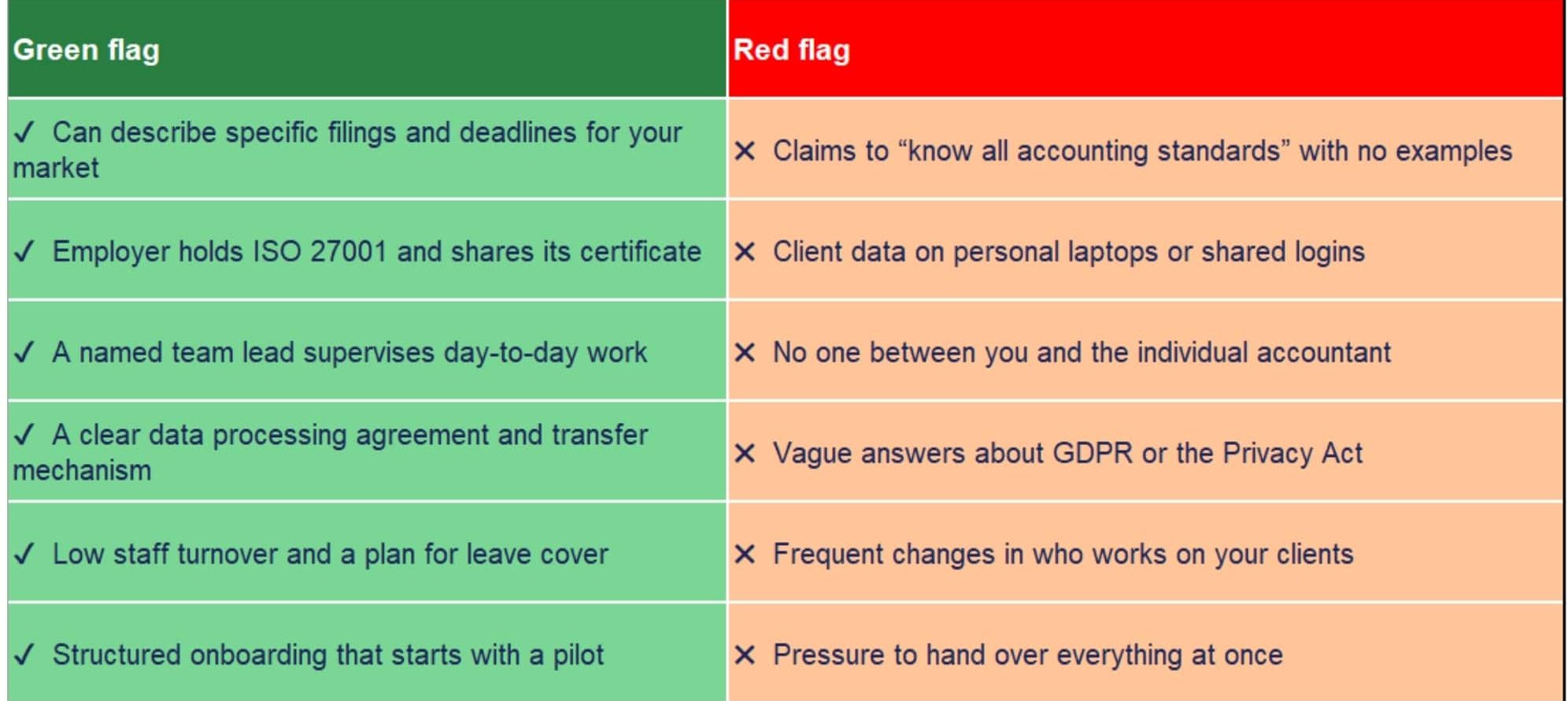
Green flags and red flags to watch for
Whether you’re assessing an individual candidate or the provider who employs them, a few signals tell you a great deal. When you hire offshore accountants, these are the ones we’d pay closest attention to.
Frequently asked questions
How much does it cost to hire offshore accountants in India?
Costs depend on experience, market specialism and the engagement model. Dedicated full-time professionals are usually charged as a fixed monthly fee per person, covering salary, benefits, equipment, office, IT security and management. For most UK, Australian and European firms that works out well below the full cost of a local hire once recruitment fees, employer taxes or superannuation and office costs are included, but the fairest comparison is the cost of finished, reviewed work rather than the hourly rate.
Do offshore accountants need UK, Australian or EU qualifications?
Not necessarily. Practical experience with your market's filings and software matters more than the qualification itself. Many Indian accountants hold ACCA or the Indian Chartered Accountant qualification, and some hold CPA Australia or CA ANZ. Whatever their qualifications, regulated responsibilities, such as lodgement by an Australian registered tax agent, stay with your firm.
Is it legal to send client data to accountants in India?
Yes, provided the right safeguards are in place. UK firms need a data processing agreement and the International Data Transfer Agreement or UK Addendum, EU firms need standard contractual clauses and a transfer impact assessment, and Australian firms covered by the Privacy Act need to take reasonable steps under APP 8. Review your engagement letters and privacy notice too, so clients know their data may be processed overseas.
How long does it take to hire offshore accountants?
Through an established provider with an existing talent pool, a dedicated accountant can often start within two to six weeks, including skills testing and onboarding. Specialist roles, such as accountants for particular EU countries, can take longer, and setting up your own offshore entity usually takes several months.
Can one offshore team support clients in several countries?
Yes, and it's one of the advantages of India's position between Australia and Europe. We'd still assign people by market, so each accountant builds depth in one set of rules, with a team lead coordinating across regions.
What hours do offshore accountants in India work?
A standard 9:30 to 18:30 India shift overlaps the UK working day by four to five hours, central Europe by five to six hours and Sydney by two and a half to three and a half hours, depending on daylight saving. Shifted hours can be arranged where you need more live collaboration.
Building your offshore team with Virtual Clone
Hiring offshore is ultimately about people: the right accountants, trained on the right market, working inside a framework you can trust. Get those three things right and an offshore team stops feeling offshore at all. It simply becomes part of how your firm gets work done.
At Virtual Clone, we help accounting firms across the UK, Australia and Europe hire offshore accountants who work as dedicated members of their team, from our delivery centres in Nagpur and Mumbai. We’re ISO 27001 and ISO 9001 certified and an ACCA Approved Employer. If you’d like to talk through the roles you need, the markets you serve or how a pilot would work, we’d be glad to help. You may also find it useful to read why UK practices are choosing India-based partners.